- O repozytorium
- Kolekcje
- Indeksy
- Historia przeglądania
-
Repozytoria RCIN
-
 INSTYTUT ARCHEOLOGII I ETNOLOGII POLSKIEJ AKADEMII NAUK
-
 INSTYTUT BADAŃ LITERACKICH POLSKIEJ AKADEMII NAUK
-
 INSTYTUT BADAWCZY LEŚNICTWA
-
 INSTYTUT BIOLOGII DOŚWIADCZALNEJ IM. MARCELEGO NENCKIEGO POLSKIEJ AKADEMII NAUK
-
 INSTYTUT BIOLOGII SSAKÓW POLSKIEJ AKADEMII NAUK
-
 INSTYTUT CHEMII FIZYCZNEJ PAN
-
 INSTYTUT CHEMII ORGANICZNEJ PAN
-
 INSTYTUT FILOZOFII I SOCJOLOGII PAN
-
 INSTYTUT GEOGRAFII I PRZESTRZENNEGO ZAGOSPODAROWANIA PAN
-
 INSTYTUT HISTORII im. TADEUSZA MANTEUFFLA POLSKIEJ AKADEMII NAUK
-
 INSTYTUT JĘZYKA POLSKIEGO POLSKIEJ AKADEMII NAUK
-
 INSTYTUT MATEMATYCZNY PAN
-
 INSTYTUT MEDYCYNY DOŚWIADCZALNEJ I KLINICZNEJ IM.MIROSŁAWA MOSSAKOWSKIEGO POLSKIEJ AKADEMII NAUK
-
 INSTYTUT PODSTAWOWYCH PROBLEMÓW TECHNIKI PAN
-
 INSTYTUT SLAWISTYKI PAN
-
 SIEĆ BADAWCZA ŁUKASIEWICZ - INSTYTUT TECHNOLOGII MATERIAŁÓW ELEKTRONICZNYCH
-
 MUZEUM I INSTYTUT ZOOLOGII POLSKIEJ AKADEMII NAUK
-
 INSTYTUT BADAŃ SYSTEMOWYCH PAN
-
 INSTYTUT BOTANIKI IM. WŁADYSŁAWA SZAFERA POLSKIEJ AKADEMII NAUK
-

Obiekt
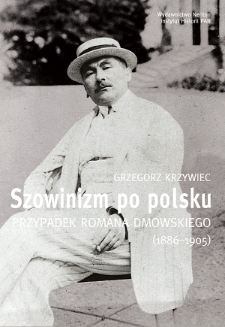
Tytuł: Szowinizm po polsku : przypadek Romana Dmowskiego (1886-1905)

Inny tytuł:
Szowinizm po polsku (pol.) ; Przypadek Romana Dmowskiego (1886-1905)
Współtwórca:
Instytut Historii Polskiej Akademii Nauk
Wydawca:
Wydawnictwo Neriton ; Instytut Historii PAN
Miejsce wydania:
Opis:
Bibliogr. s. 423-488. Indeks ; 500 s. ; 25 cm ; Streszcz. ang.
Abstrakt:
The central focus of the present book is the emergence of political radicalism at the turn of the 19th and 20th century, and especially one of its versions, rightist radicalism, represented here by Roman Dmowski, a co-founder and leader of the National Democracy. The main problem faced by the author was an attempt to reconstruct the ideological and also socio-political origins of the Polish nationalist right. In one of its possible interpretations the present book could be regarded as a contextual biography devoted to the early period of political activity of this most important ideologue and leader of nationalist movement in Poland at the turn of the 19th century. The chronological range of the book spans the period from 1886 to the outbreak of the Revolution of 1905 that in the secondary sources on the subject is usually distinguished as the time of birth of mass political parties and modern worldview. Although one of the main goals of the book is to present common dilemmas of Polish intelligentsia under the rule of the three partitioning powers, nonetheless these discussions emphasise a dominant role and place of the issues related to the territories of the Polish Kingdom or, more broadly, the whole area of the Russian partition. The author sets his text in context through the introduction presenting the discussion on the term of radicalism and difficulties resulting from applying of the term to Polish conditions. The author has assumed that the most promising approach to the study of political radicalism of the turn of the nineteenth century is the research into its ideological origins within the tensions and antinomies of liberal society of that time, the crisis seen not so much from its institutional and political aspect, as from the aspect of its concepts and ideas, as well as from the peculiarly formulated post-Enlightenment mentality. These phenomena related to the climate of cultural pessimism, often accompanied by the conviction that industrial societies had corrupted and the current forms of playing politics in the broad sense of the term had run out. This approach concerning cultural attitude owards the study of radicalisms of the turn of the 19th century seems attractive for several reasons. It provides a broader background for political movements and views’ trends emerging at that time, presenting both their comprehensive, and thus universalistic aspirations, and their dynamics in the fight against the old order. The creation of a new man, a metaphor adopted by both extremely different socialist movements, the emerging feminist movement or naturally elitist eugenic movement, and also various trends of the new right, could be considered as a symbol of that thinking. This radical tension would find its ideological and social height in totalitarianisms of the 20th century. Such approach allows us to look at the mass political movement emerging at that time taking advantage of still valid and useful research categories, such as a cultural generation, placing it on the map of ideas of those times and thus facilitating the integration of research results of social studies, study of literature and historical research as such. It opens the door to broad comparative studies and allow us to look at the ideological dilemmas of Polish elites and their views both against the broader, European backcloth or more narrow, Central European one. The starting point is the assumption that Polish proposals concerning the world views at the turn of the 19th century were the local transmission of ideological tensions and conflicts plaguing European intellectual classes at that time. The book has a polemical character. It is a discussion with dominant approaches to the studies into the emergence of Polish mass social movements, in that narrow scope which is defined by the phenomenon of intelligentsia’s radicalism, and at the same time an attempt to present a new analytic approach for the study of the turn of the centuries.
Szczegółowy typ zasobu:
Format:
Identyfikator zasobu:
oai:rcin.org.pl:64110 ; ISBN 978-83-7543-072-1
Źródło:
IH PAN, sygn. III.2631 ; IH PAN, sygn. III.2632 Podr. ; kliknij tutaj, żeby przejść
Język:
Język streszczenia:
Prawa:
Licencja Creative Commons Uznanie autorstwa-Bez utworów zależnych 4.0
Zasady wykorzystania:
Zasób chroniony prawem autorskim. [CC BY-ND 4.0 Międzynarodowe] Korzystanie dozwolone zgodnie z licencją Creative Commons Uznanie autorstwa-Bez utworów zależnych 4.0, której pełne postanowienia dostępne są pod adresem: ; -
Digitalizacja:
Instytut Historii Polskiej Akademii Nauk
Lokalizacja oryginału:
Biblioteka Instytutu Historii PAN
Dostęp:
Kolekcje, do których przypisany jest obiekt:
- Instytut Historii PAN > Książki
- Instytut Historii PAN > Wydawnictwa Instytutu
- Instytut Historii PAN > Wydawnictwa Instytutu > Książki
Data ostatniej modyfikacji:
17 wrz 2025
Data dodania obiektu:
2 sty 2018
Liczba pobrań / odtworzeń:
12514
Wszystkie dostępne wersje tego obiektu:
https://rcin.org.pl/ihpan/publication/83581
Wyświetl opis w formacie RDF:
Wyświetl opis w formacie RDFa:
Wyświetl opis w formacie OAI-PMH:
| Nazwa wydania | Data |
|---|---|
| Krzywiec, Grzegorz (1974- ), Szowinizm po polsku : przypadek Romana Dmowskiego (1886-1905) | 17 wrz 2025 |
Obiekty Podobne
Mistewicz, Teodor
Kaczmarski, Krzysztof (1965– )
Gmurczyk-Wrońska, Małgorzata (1963– )