- About project
- Collections
- Indexes
- Recently viewed
-
RCIN Repositories
-
 INSTYTUT ARCHEOLOGII I ETNOLOGII POLSKIEJ AKADEMII NAUK
-
 INSTYTUT BADAŃ LITERACKICH POLSKIEJ AKADEMII NAUK
-
 INSTYTUT BADAWCZY LEŚNICTWA
-
 INSTYTUT BIOLOGII DOŚWIADCZALNEJ IM. MARCELEGO NENCKIEGO POLSKIEJ AKADEMII NAUK
-
 INSTYTUT BIOLOGII SSAKÓW POLSKIEJ AKADEMII NAUK
-
 INSTYTUT CHEMII FIZYCZNEJ PAN
-
 INSTYTUT CHEMII ORGANICZNEJ PAN
-
 INSTYTUT FILOZOFII I SOCJOLOGII PAN
-
 INSTYTUT GEOGRAFII I PRZESTRZENNEGO ZAGOSPODAROWANIA PAN
-
 INSTYTUT HISTORII im. TADEUSZA MANTEUFFLA POLSKIEJ AKADEMII NAUK
-
 INSTYTUT JĘZYKA POLSKIEGO POLSKIEJ AKADEMII NAUK
-
 INSTYTUT MATEMATYCZNY PAN
-
 INSTYTUT MEDYCYNY DOŚWIADCZALNEJ I KLINICZNEJ IM.MIROSŁAWA MOSSAKOWSKIEGO POLSKIEJ AKADEMII NAUK
-
 INSTYTUT PODSTAWOWYCH PROBLEMÓW TECHNIKI PAN
-
 INSTYTUT SLAWISTYKI PAN
-
 SIEĆ BADAWCZA ŁUKASIEWICZ - INSTYTUT TECHNOLOGII MATERIAŁÓW ELEKTRONICZNYCH
-
 MUZEUM I INSTYTUT ZOOLOGII POLSKIEJ AKADEMII NAUK
-
 INSTYTUT BADAŃ SYSTEMOWYCH PAN
-
 INSTYTUT BOTANIKI IM. WŁADYSŁAWA SZAFERA POLSKIEJ AKADEMII NAUK
-

Object
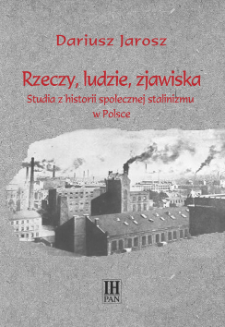
Title: Rzeczy, ludzie, zjawiska : studia z historii społecznej stalinizmu w Polsce

Subtitle:
Things, people, phenomena. Studies on social history of Stalinism in Poland
Publisher:
Place of publishing:
Description:
Wydanie I. ; 296 stron ; 24 cm ; Bibliografia na stronach 273-289. Indeks ; Streszczenie w języku angielskim.
Abstract:
The present book is a collection of studies on social history of the Stalinist period in Poland, focusing mainly on things, people, and phenomena. The studies are devoted to problems of natural environment (including effects of the implementation in Poland of the so-called “Great Stalin Plan for the Transformation of Nature”), weather anomalies and natural disasters, poverty, old age, “social history of meat”, the book (and especially its production process, distribution and reading audience), the so-called “organised holidays”, “peasantness” in the urban space, and problems of the war veteran movement. The studies in various forms have been published in specialised, subject periodicals, post-conference publications, scholarly collective publications, and broader, but hardly accessible monographs. All have been revised and updated with the recent literature on the subject and results of the author’s new individual search in archives and libraries. Final versions often present evidence of facts and establishments which originally were to be found in several, dispersed, small-run publications. In his general remarks on the research into the Stalinist period in Poland, the author claims that immediately after the political system transformation of 1989, the period of Stalinism in Poland generated interest mainly from the political perspective – as a natural reaction to earlier censorship restrictions of this research area. In this vast mass of publications on the Stalinist period in Poland studies of social history were clearly underrepresented. This led to the situation that in the popular understanding Stalinism became the archetype of the Polish People’s Republic. In the author’s opinion it resulted from the fact that in politically entangled debates on the People’s Poland raging fiercely after 1989, in their search for arguments against “the People’s Poland”, both journalists and historians most often referred to the Stalinist period. The thesis about an anti-national, non-sovereign government in conflict with the nation seemed to be most easily proved for the period between the end of 1948 and 1956. [...] An academic social history of People’s Poland written after 1989 proves that the attitude of Poles to their country in this period cannot be limited to the analysis of opposition’s activity and various forms of anti-communist resistance. When dealing with everyday existence of “average people”, the historian has to take into consideration also other forms of adaptation to life within the communist institutional order as well as to collaboration with “the system”. He has also to ask the question whether all what happened in the Polish People’s Republic due to the state authorities should be classified as immanent evil? He has also consider the fact (which is mostfully referred to in the study on the social history of meat) that in the analysed period social conflicts occurred not only between the state authorities and the people, but also between various social groups of the nation itself.
Detailed Resource Type:
Resource Identifier:
oai:rcin.org.pl:238963 ; 978-83-65880-02-4
Source:
IH PAN, sygn. II.14249 ; IH PAN, sygn. II.14248 Podr. ; click here to follow the link
Language:
Language of abstract:
Rights:
Licencja Creative Commons Uznanie autorstwa-Użycie niekomercyjne-Bez utworów zależnych 4.0
Terms of use:
Zasób chroniony prawem autorskim. [CC BY-ND 4.0 Międzynarodowe] Korzystanie dozwolone zgodnie z licencją Creative Commons Uznanie autorstwa-Bez utworów zależnych 4.0, której pełne postanowienia dostępne są pod adresem: ; -
Digitizing institution:
Instytut Historii Polskiej Akademii Nauk
Original in:
Biblioteka Instytutu Historii PAN
Access:
Object collections:
- Institute of History PAS
- Institute of History PAS > Books
- Institute of History PAS > Institute Publications
- Institute of History PAS > Institute Publications > Books
Last modified:
Sep 11, 2025
In our library since:
Jul 1, 2023
Number of object content downloads / hits:
858
All available object's versions:
https://rcin.org.pl/ihpan/publication/275181
Show description in RDF format:
Show description in RDFa format:
Show description in OAI-PMH format:
| Edition name | Date |
|---|---|
| Jarosz, Dariusz (1959– ), Rzeczy, ludzie, zjawiska : studia z historii społecznej stalinizmu w Polsce | Sep 11, 2025 |
Objects Similar
Kersten, Krystyna (1931–2008)
Topolski, Jerzy (1928–1998)
Brzostek, Błażej (1977– )
Jarosz, Dariusz (1959– )
Smosarski, Ludomir
Jarosz, Dariusz (1959– ) Miernik, Grzegorz (1960– )
Drukier, Bolesław ( –2006)