- About project
- Collections
- Indexes
- Recently viewed
-
RCIN Repositories
-
 INSTYTUT ARCHEOLOGII I ETNOLOGII POLSKIEJ AKADEMII NAUK
-
 INSTYTUT BADAŃ LITERACKICH POLSKIEJ AKADEMII NAUK
-
 INSTYTUT BADAWCZY LEŚNICTWA
-
 INSTYTUT BIOLOGII DOŚWIADCZALNEJ IM. MARCELEGO NENCKIEGO POLSKIEJ AKADEMII NAUK
-
 INSTYTUT BIOLOGII SSAKÓW POLSKIEJ AKADEMII NAUK
-
 INSTYTUT CHEMII FIZYCZNEJ PAN
-
 INSTYTUT CHEMII ORGANICZNEJ PAN
-
 INSTYTUT FILOZOFII I SOCJOLOGII PAN
-
 INSTYTUT GEOGRAFII I PRZESTRZENNEGO ZAGOSPODAROWANIA PAN
-
 INSTYTUT HISTORII im. TADEUSZA MANTEUFFLA POLSKIEJ AKADEMII NAUK
-
 INSTYTUT JĘZYKA POLSKIEGO POLSKIEJ AKADEMII NAUK
-
 INSTYTUT MATEMATYCZNY PAN
-
 INSTYTUT MEDYCYNY DOŚWIADCZALNEJ I KLINICZNEJ IM.MIROSŁAWA MOSSAKOWSKIEGO POLSKIEJ AKADEMII NAUK
-
 INSTYTUT PODSTAWOWYCH PROBLEMÓW TECHNIKI PAN
-
 INSTYTUT SLAWISTYKI PAN
-
 SIEĆ BADAWCZA ŁUKASIEWICZ - INSTYTUT TECHNOLOGII MATERIAŁÓW ELEKTRONICZNYCH
-
 MUZEUM I INSTYTUT ZOOLOGII POLSKIEJ AKADEMII NAUK
-
 INSTYTUT BADAŃ SYSTEMOWYCH PAN
-
 INSTYTUT BOTANIKI IM. WŁADYSŁAWA SZAFERA POLSKIEJ AKADEMII NAUK
-

Object
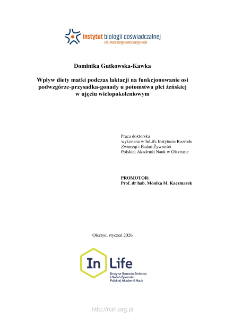
Title: Wpływ diety matki podczas laktacji na funkcjonowanie osi podwzgórze-przysadka-gonady u potomstwa płci żeńskiej w ujęciu wielopokoleniowym : praca doktorska
Contributor:
Kaczmarek, Monika M. : Supervisor
Publisher:
Instytut Rozrodu Zwierząt i Badań Żywności PAN
Place of publishing:
Description:
166 pages : illustrations ; 30 cm ; Bibliography ; Summary in English
Degree name:
Degree discipline :
Degree grantor:
Nencki Institute of Experimental Biology PAS ; degree obtained: 26.06.2026
Type of object:
Abstract:
During early development, including fetal life and the early postnatal period, the organism is highly sensitive to environmental influences, particularly maternal ones. Both nutrient deficiency and excess can shape offspring development and may even have multigenerational effects. In mice, the hypothalamic–pituitary–gonadal (HPG) axis undergoes intensive maturation during the postnatal period and is co-regulated by kisspeptin neurons located in the anteroventral periventricular/periventricular nucleus (AVPV/PeN) and the arcuate nucleus (ARC). Leptin, a key signal of the body’s metabolic status, plays an important role in the maturation of ARC neuronal circuits. The aim of this study was to investigate how transient maternal undernutrition during lactation (reduced supply of energy, nutrients, and bioactive compounds in milk) affects HPG axis function in F1 females, and whether these effects are also present in the F2 generation, which was not directly exposed to undernutrition. After parturition, F0 dams and their litters (F1) were assigned to the following groups: CON (fed ad libitum) and LUN (receiving 50% of the food intake of the control group during lactation). The F2 generation was obtained from CON × CON (CC), LUN × CON (LC), and LUN × LUN (LL) matings, and fed ad libitum. In F1 females, phenotype was assessed (body weight and composition, pubertal development, fertility, hormonal profile, and folliculogenesis), molecular and metabolic changes (ovarian RNA-seq, oocyte metabolic potential), and hypothalamic regulation of the HPG axis (the kisspeptin system, estradiol signaling, KNDy neurons, and leptin receptor-expressing neurons in the ARC). We also analyzed ARC axon growth in response to leptin during the postnatal peak of circulating leptin. A similar set of analyses was performed in F2 females. Transient nutritional stress caused persistent reductions in body weight and adiposity in LUN females, initially with lower plasma leptin. Compared with CON, LUN females also showed lower androstenedione and higher LH levels. Additionally, they had fewer secondary and antral follicles, consistent with an age-related decline in reproductive potential. Molecular analyses revealed metabolic reprogramming of the ovaries (changes in genes related to lipid metabolism and steroidogenesis) and oocytes (increased lipid content, higher mitochondrial potential, and altered redox status). In the hypothalamus of LUN females, reduced Kiss1 expression in the AVPV/PeN, increased Lepr expression in the ARC, and elevated ERα expression in the AVPV/PeN were found on postnatal day 21. Undernutrition also decreased the overall sensitivity of ARC neurons to leptin stimulation, while preserving the response of kisspeptin neurons. In the F2 generation, the strongest effects were observed in the LL group: on postnatal day 21, these females had lower body weight, reduced adiposity, and higher estradiol levels, and they exhibited delayed vaginal opening compared with the CC group. Although phenotypic differences largely disappeared in adulthood, selected metabolic alterations in oocytes (lipids, mitochondrial potential, redox status) and some ovarian gene expression changes persisted, similar to those observed in F1. In summary, maternal undernutrition during lactation induces extensive and long-lasting alterations in the reproductive axis of female offspring—from hypothalamic-hormonal regulation, through ovarian function, to the metabolism of individual oocytes. Some of these changes persist in the F2 generation, indicating multigenerational transmission of its effects. Reprogramming of oocyte lipid and energy metabolism may play a key role in mediating the transmission of nutritional stress effects to subsequent generations. This study provides the first comprehensive analysis of undernutrition during a critical developmental window and highlights new directions for research on multigenerational nutritional programming of female fertility.
Detailed Resource Type:
Resource Identifier:
Source:
Language:
Language of abstract:
Rights:
Terms of use:
Copyright-protected material. May be used within the limits of statutory user freedoms
Copyright holder:
Publication made available with the written permission of the author
Digitizing institution:
Nencki Institute of Experimental Biology of the Polish Academy of Sciences
Original in:
Library of the Nencki Institute of Experimental Biology PAS
Access:
Object collections:
- Nencki Institute of Experimental Biology PAS
- Nencki Institute of Experimental Biology PAS > Dissertations > PhD Thesis
Last modified:
Jul 1, 2026
In our library since:
Jun 24, 2026
Number of object content downloads / hits:
24
All available object's versions:
https://rcin.org.pl/ibd/publication/300022
Show description in RDF format:
Show description in RDFa format:
Show description in OAI-PMH format:
Objects Similar
Darwin, Charles Robert (1809–1882)
Dziedzicki, Henryk (1847–1921)
Przibram, Hans (1874–1944)
Korschelt, Eugen (1858–1946) Heider, Karl (1856–1935)