- About project
- Collections
- Indexes
- Recently viewed
-
RCIN Repositories
-
 INSTYTUT ARCHEOLOGII I ETNOLOGII POLSKIEJ AKADEMII NAUK
-
 INSTYTUT BADAŃ LITERACKICH POLSKIEJ AKADEMII NAUK
-
 INSTYTUT BADAWCZY LEŚNICTWA
-
 INSTYTUT BIOLOGII DOŚWIADCZALNEJ IM. MARCELEGO NENCKIEGO POLSKIEJ AKADEMII NAUK
-
 INSTYTUT BIOLOGII SSAKÓW POLSKIEJ AKADEMII NAUK
-
 INSTYTUT CHEMII FIZYCZNEJ PAN
-
 INSTYTUT CHEMII ORGANICZNEJ PAN
-
 INSTYTUT FILOZOFII I SOCJOLOGII PAN
-
 INSTYTUT GEOGRAFII I PRZESTRZENNEGO ZAGOSPODAROWANIA PAN
-
 INSTYTUT HISTORII im. TADEUSZA MANTEUFFLA POLSKIEJ AKADEMII NAUK
-
 INSTYTUT JĘZYKA POLSKIEGO POLSKIEJ AKADEMII NAUK
-
 INSTYTUT MATEMATYCZNY PAN
-
 INSTYTUT MEDYCYNY DOŚWIADCZALNEJ I KLINICZNEJ IM.MIROSŁAWA MOSSAKOWSKIEGO POLSKIEJ AKADEMII NAUK
-
 INSTYTUT PODSTAWOWYCH PROBLEMÓW TECHNIKI PAN
-
 INSTYTUT SLAWISTYKI PAN
-
 SIEĆ BADAWCZA ŁUKASIEWICZ - INSTYTUT TECHNOLOGII MATERIAŁÓW ELEKTRONICZNYCH
-
 MUZEUM I INSTYTUT ZOOLOGII POLSKIEJ AKADEMII NAUK
-
 INSTYTUT BADAŃ SYSTEMOWYCH PAN
-
 INSTYTUT BOTANIKI IM. WŁADYSŁAWA SZAFERA POLSKIEJ AKADEMII NAUK
-

Object
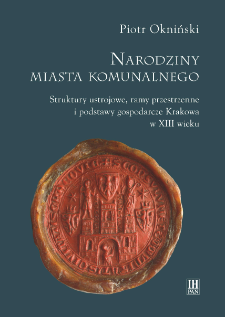
Title: Narodziny miasta komunalnego : struktury ustrojowe, ramy przestrzenne i podstawy gospodarcze Krakowa w XIII wieku

Subtitle:
Contributor:
Polska Akademia Nauk. Instytut Historii im. Tadeusza Manteuffla
Publisher:
Place of publishing:
Description:
Wydanie I. ; 204 pages ; 21 cm ; Based on doctoral thesis (Wydział Historyczny, Uniwersytet Warszawski, 2016). ; Bibliography (pages 148-186). Indexes. ; Summary in English
Abstract:
This study presents the process of formation of a municipality in Cracow in the thirteenth century. The author defines the title communal town in reference to the definition of so-called Western city formulated by Max Weber. According to this popular concept, the most important distinction between the Western (or Occidental) and Eastern (or Oriental) city is its political autonomy. Usually, the Polish literature on the subject indicates as the actual opening of the process of forming a municipality in Cracow the suppression of the so-called rebellion of Mayor Albert of 1311–1312, or a rebellion of Cracow townsmen against Duke Władysław I the Short. It was accepted that only the abolition of hereditary mayoralty after the suppression of Mayor Albert’s mutiny made it possible to politically strengthen the position of Cracow self-government, that is the municipal council. Contrary to this stance, the author argues that the rebellion of 1311–1312 marked the final rather than initial date of the first, dimly lit by the sources, stage of the formation of communal town in Cracow. The first germs of Cracow self-governing community were established as early as the first half of the thirteenth century, and their consolidation was made when the town was chartered under the Magdeburg Law in 1257. The development of the urban community accelerated at times of weakened supreme authority in Lesser Poland (Małopolska) region in the last quarter of the thirteenth and early fourteenth century, and was brought to an abrupt halt due to consolidation of territorial power by Duke Władysław the Short. The title transformations were interpreted from three mutually complementary perspectives. Chapter one discusses the crystallisation in Cracow of an urban community as a legal political entity with its own judicial and self-governing system, with definite political aspirations. Chapter two presents the process of territorial shaping of chartered community, with clearly defined borders and its own characteristic church topography and urban tissue. Chapter three is devoted to the genesis of the communal town as a peculiar “enterprise”, that is the centre of autonomous commercial and manufacturing activities, the centre of capital concentration, and an institutions with its own wealth and fiscal system. The last chapter reconstructs the course and consequences of Mayor Albert’s rebellion. The author demonstrates that the suppression of the revolt resulted not only in the breaking of communal aspirations of Cracow burghers but also determined Cracow place within the socio-political structures of the Polish monarchy for a long time.
Detailed Resource Type:
Resource Identifier:
oai:rcin.org.pl:140007 ; 978-83-65880-54-3
Source:
IH PAN, call no. I.10933 ; IH PAN, call no. I.10932 Podr. ; IH PAN, call no. I.10935 SHG Kraków ; IH PAN, call no. I.10934 SHG Poznań ; click here to follow the link
Language:
Language of abstract:
Rights:
Creative Commons Attribution BY-ND 4.0 license
Terms of use:
Copyright-protected material. [CC BY-ND 4.0] May be used within the scope specified in Creative Commons Attribution BY-ND 4.0 license, full text available at: ; -
Digitizing institution:
Institute of History of the Polish Academy of Sciences
Original in:
Library of the Institute of History PAS
Access:
Object collections:
- Institute of History PAS > Books
- Institute of History PAS > Institute Publications
- Institute of History PAS > Institute Publications > Books
Last modified:
Sep 12, 2025
In our library since:
Sep 19, 2020
Number of object content downloads / hits:
1602
All available object's versions:
https://rcin.org.pl/ihpan/publication/174021
Show description in RDF format:
Show description in RDFa format:
Show description in OAI-PMH format:
Objects Similar
Lenard, Ewa
Starzyński, Marcin (1981– )
Okniński, Piotr (1989– )