- About project
- Collections
- Indexes
- Recently viewed
-
RCIN Repositories
-
 INSTYTUT ARCHEOLOGII I ETNOLOGII POLSKIEJ AKADEMII NAUK
-
 INSTYTUT BADAŃ LITERACKICH POLSKIEJ AKADEMII NAUK
-
 INSTYTUT BADAWCZY LEŚNICTWA
-
 INSTYTUT BIOLOGII DOŚWIADCZALNEJ IM. MARCELEGO NENCKIEGO POLSKIEJ AKADEMII NAUK
-
 INSTYTUT BIOLOGII SSAKÓW POLSKIEJ AKADEMII NAUK
-
 INSTYTUT CHEMII FIZYCZNEJ PAN
-
 INSTYTUT CHEMII ORGANICZNEJ PAN
-
 INSTYTUT FILOZOFII I SOCJOLOGII PAN
-
 INSTYTUT GEOGRAFII I PRZESTRZENNEGO ZAGOSPODAROWANIA PAN
-
 INSTYTUT HISTORII im. TADEUSZA MANTEUFFLA POLSKIEJ AKADEMII NAUK
-
 INSTYTUT JĘZYKA POLSKIEGO POLSKIEJ AKADEMII NAUK
-
 INSTYTUT MATEMATYCZNY PAN
-
 INSTYTUT MEDYCYNY DOŚWIADCZALNEJ I KLINICZNEJ IM.MIROSŁAWA MOSSAKOWSKIEGO POLSKIEJ AKADEMII NAUK
-
 INSTYTUT PODSTAWOWYCH PROBLEMÓW TECHNIKI PAN
-
 INSTYTUT SLAWISTYKI PAN
-
 SIEĆ BADAWCZA ŁUKASIEWICZ - INSTYTUT TECHNOLOGII MATERIAŁÓW ELEKTRONICZNYCH
-
 MUZEUM I INSTYTUT ZOOLOGII POLSKIEJ AKADEMII NAUK
-
 INSTYTUT BADAŃ SYSTEMOWYCH PAN
-
 INSTYTUT BOTANIKI IM. WŁADYSŁAWA SZAFERA POLSKIEJ AKADEMII NAUK
-

Object
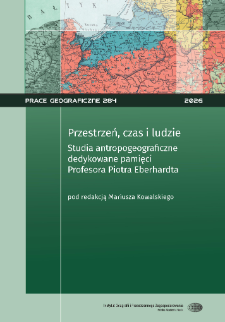
Title: Przestrzenna ciągłość i systematyczność depopulacji w Polsce (1950‑2023)


Subtitle:
Część I. Współczesna Polska w badaniach antropogeograficznych ; Przestrzeń, czas i ludzie : studia antropogeograficzne dedykowane pamięci Profesora Piotra Eberhardta = Space, Time and People : anthropogeographical studies dedicated to the memory of Professor Piotr Eberhardt ; Prace Geograficzne = Geographical Studies / Polska Akademia Nauk. Instytut Geografii i Przestrzennego Zagospodarowania im. Stanisława Leszczyckiego, nr 284
Institutional creator:
Publisher:
Instytut Geografii i Przestrzennego Zagospodarowania, Polska Akademia Nauk
Place of publishing:
Description:
295 pages : color illustrations :24 cm ; Bibliography at the end of chapters ; English summary
Abstract:
This volume is dedicated to the memory of Professor Piotr Eberhardt, who devoted 65 years of his life to geography—first as a student of the discipline at the University of Warsaw, and then, until the end of his days, as a scholar affiliated for six decades with the Institute of Geography and Spatial Organization of the Polish Academy of Sciences in Warsaw. The publication comes one year after the 90th anniversary of his birth and the 5th anniversary of his death The co-authors of this volume and the community of the Institute of Geography and Spatial Organization of the Polish Academy of Sciences wish, through this publication, to pay tribute to and express their appreciation for the achievements of this outstanding scholar, including the role he played in the development of Polish geography and as a mentor and teacher to many students of socio-economic geography and related fields. The volume is divided into four parts. The first three contains substantive studies addressing topics inspired to a greater or lesser extent by Professor Eberhardt’s work, interests, or family background. Thus, M. Barwiński discusses the issue of nationality in cartography, A. Eberhardt examines the figure of Professor Włodzimierz Wakar’s grandfather, and K. Kocsis addresses issues of border and ethnic changes in relation to Hungary. M. Kowalski’s study is devoted to issues of religious diversity and voting behavior, while the work by K. Leśniewska-Napierała and T. Napierała addresses the economic determinants of local elections. R. Matykowski undertook an analysis of the phenomenon of multiple capitals, A. Miszczuk presented an assessment of the country’s territorial-administrative reform; A. Rykała and M. Kuliś presented their reflections on the commemoration of Holocaust victims; M. Sobczyński analyzed the Soviet authorities’ nationality policy; and R. Szul presented geopolitical reflections on the concept of the nation. The fourth part featured statements from individuals who shared their memories and reflections drawn from their direct interactions with Professor Eberhardt (T. Komornicki, M. Kowalski, A. Miszczuk, A. Smalianczuk).
References:
Atlas Rzeczypospolitej Polskiej (1993‑1997). Warszawa: Główny Geodeta Kraju.
van den Berg, L., Drewett, R., Klaassen, L.H., Rossi, A., & Vijverberg, C.H.T. (red.). (1982). Urban Europe: Study of Growth and Decline. Oxford: Pergamon Press.
Eberhardt, P. (1986). Les régions de dépeuplement en Pologne orientale. Espace, Populations, Sociétés, 3, 117‑120. https://doi.org/10.3406/espos.1986.1169

Eberhardt, P. (1989). Regiony wyludniające się w Polsce. Prace Geograficzne, 148, Wrocław: Zakład Narodowy im. Ossolińskich.
Eberhardt, P. (1990). Wyludnianie się obszarów wiejskich w Polsce. Wieś i Rolnictwo, 2, 62‑77.
Eberhardt, P. (2012). Stopień trafności polskich prognoz demograficznych. Czasopismo Geograficzne, 83(1‑2), 3‑28.
Eberhardt, P. (2014). Fazy rozwoju demograficznego Polski. Roczniki Nauk Społecznych, 42, 135‑160.
Gąsior-Niemiec, A. (2006). Europa jako kontynent imigracyjny. Zarys problemu. W: A. Kukliński, K. Pawłowski (red.), Przyszłość Europy - wyzwania globalne. Wybory strategiczne (s. 88‑98). Nowy Sącz: Wyższa Szkoła Biznesu.
Goodhart, Ch., & Pradhan, M. (2024). Wielki Zwrot Demograficzny. Warszawa: Wyd. WEI.
Heffner, K., & Gibas, P. (2014). Zasięg stref oddziaływania metropolii. Studia Miejskie, 13, 9‑26.
Hrynkiewicz, J. (2020). Depopulacja wyzwaniem polityki ludnościowej. W: J. Hrynkiewicz, & G. Ślusarz (red.), Depopulacja. Uwarunkowania i konsekwencje (s. 19‑37). Biblioteka Wiadomości Statystycznych, 68, Warszawa: GUS, Rządowa Rada Ludnościowa.
Hrynkiewicz, J. (red.) (2023). Polska XXI wiek - wyzwania demograficzne. III Kongres Demograficzny w Polsce 2022. Warszawa: Rządowa Rada Ludnościowa, GUS.
Jończy, R., & Boichuk, N. (2026). Nierejestrowane wyludnienie, migracje i zatrudnienie. Wnioski z badań mikrospisowych w wybranych wsiach Polski. Opole: Uniwersytet Opolski.
van de Kaa, D.J. (1987). Europe's second demographic transition. Population Bulletin, 42(1), 1‑59.
Khavarian-Garmsir, A.R. (2023). A systematic review of shrinking cities literature: lessons from the past and directions for the future. International Planning Studies, 28(3‑4), 219‑238. https://doi.org/10.1080/13563475.2023.2205030
Korcelli, P. (2008). System osadniczy Polski - tendencje i uwarunkowania przemian. Studia KPZK PAN, 122, 30‑42.
Kulikowski, R. (1986). Depressed areas in Polish private farming. Conference Papers (IGSO PAS), 24, 137‑144.
Loras-Gimeno, D., Díaz-Lanchas, J., & Gómez-Bengoechea, G. (2025). Rural depopulation in the 21st century: A systematic review of policy assessments. Regional Science Policy & Practice, 17(5), 100176. https://doi.org/10.1016/j.rspp.2025.100176
Stanny, M. (2012). Dynamika zmian demograficznych ludności wiejskiej i jej zasobów pracy. Polityka Społeczna, 39(7), 1‑9.
Stanny, M., Rosner, A., & Komorowski, Ł. (2023). Monitoring rozwoju obszarów wiejskich. Etap IV. Dekada przemian społeczno-gospodarczych. Warszawa: Fundacja Europejski Fundusz Rozwoju Wsi Polskiej, Instytut Rozwoju Wsi i Rolnictwa PAN. https://doi.org/10.53098/MROW.2720-376X
Stasiak, A. (1965). Wpływ procesów uprzemysłowienia na strukturę ludności wiejskiej województwa katowickiego. Wiadomości Statystyczne, 10(5), 9‑13.
Stasiak, A. (1972). Problem "płynności" ludności wiejskiej. Seria "Ludność", Warszawa: GUS, 124‑146.
Stasiak, A., & Eberhardt, P. (1995). Gęstość i zmiany zaludnienia 1950‑1992. W: Atlas Rzeczypospolitej Polskiej (cz. 3, arkusz 62.2). Warszawa: Główny Geodeta Kraju.
Śleszyński, P. (2013). Demographic changes in the functional urban areas in Poland, 2000‑2010. Geographia Polonica, 86(2), 169‑170. https://doi.org/10.7163/GPol.2013.16
Śleszyński, P. (2018). Demograficzne wyzwania rozwoju regionalnego Polski. Studia KPZK PAN, 183, 225‑247.
Śleszyński, P. (2025). "Raport o przestrzennej depopulacji i migracjach młodych dorosłych w Polsce" wykonany w ramach projektu pt. "Wypracowanie rozwiązań służących przeciwdziałaniu migracji osób młodych z terenów dotkniętych depopulacją". Opole: Centrum Badań Migracji, Depopulacji i Rozwoju Uniwersytetu Opolskiego. https://www.gov.pl/attachment/402f4661‑709d-442a-a36a-cc60b8771993 (7.01.2026).
Śleszyński, P. (2026). Delimitacja i klasyfikacja obszarów depopulacyjnych w Polsce. Przegląd Geograficzny, 98(1), 5-37. https://doi.org/10.7163/PrzG.2026.1.1
Śleszyński, P., & Komornicki, T. (2016). Klasyfikacja funkcjonalna gmin Polski na potrzeby monitoringu planowania przestrzennego. Przegląd Geograficzny, 88(4), 469‑488. https://doi.org/10.7163/PrzG.2016.4.3
United Nations (2024). World Population Prospects 2024. New York: United Nations. https://population.un.org/wpp/assets/Files/WPP2024_Summary-of-Results.pdf (3.07.2026).
Vollset, S.E., Goren, E., Yuan, C.W., Cao, J., Smith, A.E., Hsiao, T., Bisignano, C., Azhar, G.S., Castro, E., Chalek, J., Dolgert, A.J., Frank, T., Fukutaki, K., Hay, S.I., Lozano, R., Mokdad, A.H., Nandakumar, V., Pierce, M., Pletcher, M., Robalik, T., Steuben, K.M., Wunrow, H.Y., Zlavog, B.S., & Murray, C.J.L. (2020). Fertility, mortality, migration, and population scenarios for 195 countries and territories from 2017 to 2100: A forecasting analysis for the Global Burden of Disease Study. The Lancet, 396(10258), 1285‑1306. https://doi.org/10.1016/S0140-6736(20)30677-2
Relation:
Prace Geograficzne - Polska Akademia Nauk
Start page:
End page:
Detailed Resource Type:
Resource Identifier:
oai:rcin.org.pl:263477 ; 978-83-973494-8-3 (oprawa miękka) ; 978-83-973494-9-0 (pdf) ; 10.7163/9788397349490.04
Language:
Language of abstract:
Rights:
Creative Commons Attribution BY-SA 4.0 license
Terms of use:
Copyright-protected material. [CC BY-SA 4.0] May be used within the scope specified in Creative Commons Attribution BY-SA 4.0 license, full text available at: ; -
Digitizing institution:
Institute of Geography and Spatial Organization of the Polish Academy of Sciences
Original in:
Projects co-financed by:
Programme Innovative Economy, 2010-2014, Priority Axis 2. R&D infrastructure ; European Union. European Regional Development Fund
Access:
Object collections:
- Institute of Geography and Spatial Organization PAS (IGiPZ PAN) > Publications of IGiPZ PAN and employees
- Institute of Geography and Spatial Organization PAS (IGiPZ PAN) > Library > Books
- Institute of Geography and Spatial Organization PAS (IGiPZ PAN) > Library > Series/Journals/Periodics
Last modified:
Nov 2, 2026
In our library since:
Nov 2, 2026
Number of object content downloads / hits:
6
All available object's versions:
https://rcin.org.pl/igipz/publication/300589
Show description in RDF format:
Show description in RDFa format:
Show description in OAI-PMH format:
| Edition name | Date |
|---|---|
| Śleszyński P. : Przestrzenna ciągłość i systematyczność depopulacji w Polsce (1950‑2023) | Nov 2, 2026 |
Objects Similar
Śleszyński, Przemysław
Śleszyński, Przemysław
Śleszyński, Przemysław
Kowalski, Mariusz Śleszyński, Przemysław
Kosiński, Leszek (1929– ) Śleszyński, Przemysław
Węcławowicz, Grzegorz Jarosz, Andrzej Śleszyński, Przemysław
Śleszyński, Przemysław
Śleszyński, Przemysław