- O repozytorium
- Kolekcje
- Indeksy
- Historia przeglądania
-
Repozytoria RCIN
-
 INSTYTUT ARCHEOLOGII I ETNOLOGII POLSKIEJ AKADEMII NAUK
-
 INSTYTUT BADAŃ LITERACKICH POLSKIEJ AKADEMII NAUK
-
 INSTYTUT BADAWCZY LEŚNICTWA
-
 INSTYTUT BIOLOGII DOŚWIADCZALNEJ IM. MARCELEGO NENCKIEGO POLSKIEJ AKADEMII NAUK
-
 INSTYTUT BIOLOGII SSAKÓW POLSKIEJ AKADEMII NAUK
-
 INSTYTUT CHEMII FIZYCZNEJ PAN
-
 INSTYTUT CHEMII ORGANICZNEJ PAN
-
 INSTYTUT FILOZOFII I SOCJOLOGII PAN
-
 INSTYTUT GEOGRAFII I PRZESTRZENNEGO ZAGOSPODAROWANIA PAN
-
 INSTYTUT HISTORII im. TADEUSZA MANTEUFFLA POLSKIEJ AKADEMII NAUK
-
 INSTYTUT JĘZYKA POLSKIEGO POLSKIEJ AKADEMII NAUK
-
 INSTYTUT MATEMATYCZNY PAN
-
 INSTYTUT MEDYCYNY DOŚWIADCZALNEJ I KLINICZNEJ IM.MIROSŁAWA MOSSAKOWSKIEGO POLSKIEJ AKADEMII NAUK
-
 INSTYTUT PODSTAWOWYCH PROBLEMÓW TECHNIKI PAN
-
 INSTYTUT SLAWISTYKI PAN
-
 SIEĆ BADAWCZA ŁUKASIEWICZ - INSTYTUT TECHNOLOGII MATERIAŁÓW ELEKTRONICZNYCH
-
 MUZEUM I INSTYTUT ZOOLOGII POLSKIEJ AKADEMII NAUK
-
 INSTYTUT BADAŃ SYSTEMOWYCH PAN
-
 INSTYTUT BOTANIKI IM. WŁADYSŁAWA SZAFERA POLSKIEJ AKADEMII NAUK
-
- Wyszukaj w całym Repozytorium
- Piśmiennictwo i mapy
- Archeologia
- Baza Młynów
- Nauki przyrodnicze
Wyszukiwanie zaawansowane
Wyszukiwanie zaawansowane
Wyszukiwanie zaawansowane
Wyszukiwanie zaawansowane
Wyszukiwanie zaawansowane

Obiekt
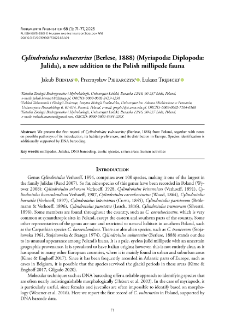
Tytuł: Cylindroiulus vulnerarius (Berlese, 1888) (Myriapoda: Diplopoda:Julida), a new addition to the Polish millipede fauna
Twórca:
Bienias, Jakub
 ;
Piekarczyk, Przemysław
;
Trębicki, Łukasz
;
Piekarczyk, Przemysław
;
Trębicki, Łukasz
Data wydania/powstania:
Typ zasobu:
Inny tytuł:
Cylindroiulus vulnerarius new to Polish fauna ; Cylindroiulus vulnerarius (Berlese, 1888) (Myriapoda: Diplopoda: Julida), nowy gatunek wfaunie krocionogów Polski
Wydawca:
Muzeum i Instytut Zoologii Polskiej Akademii Nauk
Miejsce wydania:
Opis:
Typ obiektu:
Abstrakt:
We present the first record of Cylindroiulus vulnerarius (Berlese, 1888) from Poland, together with notes on possible pathways of its introduction, its habitat preferences, and its distribution in Europe. Species identification is additionally supported by DNA barcoding
Bibliografia:
Berlese A. 1888. Acari, Myriopoda et Scorpiones hucusque in Italia reperta. Volumen VI. Fasc. LI-LX. Sumptibus Auctoris,Padova, 10 pp.
Bienias J., Voigtländer K., Trębicki Ł., Kościelniak J., Grabowski M. 2025. Overlooked expansion? Te case of the millipedePolydesmus angustus Latzel, 1884 in Poland. BioInvasions Records, 14(1): 31–45.
Blower J.G., Rolfe S.W. 1956. Metaiulus pratensis, gen. et sp. nov., and Leptoiulus kervillei (Brölemann) (Diplopoda, Iulidae)from Britain. Journal of Natural History, 9(103): 513–520.
Brölemann H. W. 1896. Matériaux pour servir a une faune des myriapodes de France. Feuille des jeunes naturalistes, 26(311):214–218.
Curtis J. 1845. Observations on the natural history and economy of the insects called wireworms, etc. Journal of the RoyalAgricultural Society of England, 5(1): 180–237.
De Geer C. 1778. Mémoires pour servir à l’histoire des insectes. Tome VII - P. Hesselberg, Stockholm, VI+950 pp.
Decker M.P., Reip H.S., Voigtländer K. 2014. Millipedes and centipedes in German greenhouses (Myriapoda: Diplopoda,Chilopoda). Biodiversity Data Journal, 2: e1066.
Edgar R.C. 2004. MUSCLE: Multiple sequence alignment with high accuracy and high throughput. Nucleic Acids Research,32: 1792–1797.
Felsenstein J. 1985. Confdence limits on phylogenies: An approach using the bootstrap. Evolution, 39: 783–791.
Gilgado J.D. 2020. Hidden in plain sight: six millipede species (Myriapoda: Diplopoda) new for the fauna of Switzerland.Revue suisse de Zoologie, 127(2): 249–259.
Haľková B., Drabová M., Mock A. 2021. An annotated checklist of millipede fauna from Slovakia, with ecological and biogeographiccharacteristics. Biodiversity Data Journal, 9: e71495.
Hebert P. D.N., Cywinska A., Ball S.L., Dewaard J.R. 2003. Biological identifcations through DNA barcodes. Proceedingsof the Royal Society of London. Series B: Biological Sciences, 270: 313–321.
Kearse M., Moir R., Wilson A., Stones-Havas S., Cheung M., Sturrock S., Buxton S., Cooper A., Markowitz S., Duran C.,Tierer T., Ashton B., Meintjes P., Drummond A. 2012. Geneious Basic: An integrated and extendable desktop softwareplatform for the organization and analysis of sequence data. Bioinformatics, 28: 1647–1649.
Kime R.D., Enghof H. 2017. Atlas of European Millipedes 2: Order Julida (Class Diplopoda). European Journal of Taxonomy,346: 1–299.
Kimura M. 1980. A simple method for estimating evolutionary rates of base substitutions through comparative studies ofnucleotide sequences. Journal of Molecular Evolution, 16: 111–120.
Koch C. L. 1835. Deutschlands Crustaceen Myriapoden und Arachniden. In: (Panzer) Herrich-Schaefer’s DeutschlandsInsecten - Pustet, Regensburg, Heft 136.
Koch, C.L. 1847. Den Verzeichnissen und Berichtigungen zu Deutschlands Crustaceen, Myriapoden und Arachniden undein System der Myriapoden. In: Panzer G.W.F., Herrich-Schäfer A. (eds.), Kritische Revision der Insectenfaune Deutschlands.3: 1–272.
Kocourek P. 2003. Two millipede species (Diplopoda) new to Bulgaria. African Invertebrates, 44(1): 199–202.
Leach W.E. 1816. XXXI. A tabular view of the external characters of four classes of animals, which Linné arranged underInsecta; with the distribution of the genera composing three of these classes into orders, &c and descriptions of severalnew genera and species. Transactions of the Linnean Society of London. 11(2): 306–400.
Linnaeus C. 1758. Systema Naturae per regna tria naturae, secundum classes, ordines, genera, species, cum characteribus,diferentiis, synonymis, locis. Editio Decima, Reformata. Tomus I. Laurenti Salvi, Holmiae, 824 pp.
Portal Systemu Informacji Przestrzennej Miasta Szczecin. 2025. Portal Systemu Informacji Przestrzennej Miasta Szczecin[Spatial information system portal of the city of Szczecin]. Available from: https://geoportal.szczecin.eu; accessed on:01.06.2025.
Querner P., Szucsich N., Landsberger B., Erlacher S., Trebicki L., Grabowski M., Brimblecombe P. 2022. Identifcation andspread of the ghost silverfsh (Ctenolepisma calvum) among museums and homes in Europe. Insects, 13, 855.
Ratnasingham S., Hebert P. D.N. 2007. BOLD: Te Barcode of Life Data System (http://www.barcodinglife.org). MolecularEcology Resources, 7: 355–364.
Read H.J. 2007. Te millipede genus Cylindroiulus Verhoef, 1894 in north-west Spain and northern Portugal: recent recordsand descriptions of four new species (Diplopoda, Julida, Julidae). Graellsia, 63(2): 279–294.
Saitou N., Nei M. 1987. Te neighbor-joining method: a new method for reconstructing phylogenetic trees. MolecularBiology and Evolution, 4: 406–425.
Shaw G. 1794. Remarks on Scolopendra electrica, and Sc. subterranea - Transactions of the Linnean Society of London, 2(1794): 7–9.
Silvestri F. 1896. Una escursione in Tunisia (Symphyla, Chilopoda, Diplopoda). il Naturalista siciliano, Nuova Serie, 15(8–12): 143–161.
Stojałowska W. 1961. Krocionogi (Diplopoda) Polski. PWN, Warszawa, 216 pp.
Stojałowska W., Staręga W. 1974. Krocionogi – Diplopoda. Katalogu fauny Polski 21: 1–71.
Tamura K., Stecher G., Kumar S. 2021. MEGA11: Molecular Evolutionary Genetics Analysis version 11. Molecular Biologyand Evolution, 38: 3022–3027.
Verhoef K.W. 1908. Über Diplopoden. 10.(30.) Aufsatz: Zur Kenntnis der Juliden und über einige Polydesmiden. Archivfür Naturgeschichte, 73(1): 423–474.
Verhoef K.W. 1891. Ein Beitrag zur mitteleuropäischen Diplopodenfauna. Berliner entomologische Zeitschrift, 36(1):115–166. Berlin.
Verhoef K.W. 1897. Diplopodenfauna Siebenbürgens. Verhandlungen der Zoologisch-botanischen Gesellschaft in Wien,47: 454–472.
Verhoef K.W. 1907. Über Diplopoden. 6. (26.) Aufsatz: Tausendfüssler aus Brandenburg und andere Formen aus Ostdeutschlandund Österreich-Ungarn. Mitteilungen aus dem Zoologischen Museum in Berlin, 3(3): 261–337.
Verhoef K.W. 1928. Neue und besonders ostalpine Chilognathen-Beiträge. 108. Diplopoden-Aufsatz. Zoologische Jahrbücher,Abteilung für Systematik, Ökologie und Geographie der Tiere, 55: 253–328. Jena.
Wesener T., Voigtländer K., Decker P., Oeyen J. P., Spelda J. 2016. Barcoding of Central European Cryptops centipedes revealslarge interspecifc distances with ghost lineages and new species records from Germany and Austria (Chilopoda, Scolopendromorpha).ZooKeys, 564: 21–46.
Wood H.C. 1864. Descriptions of new species of North American Iulidae. Proceedings of the Academy of natural Science ofPhiladelphia, 1864: 10–15.
Wytwer J. 2008. Wije (Myriapoda). In: Bogdanowicz W., Chudzicka E., Pilipiuk I., Skibi ska E. (eds), Fauna Polski. Charakterystykai wykaz gatunków. Volume III. Muzeum i Instytut Zoologii PAN, Warszawa: 327–345.
Czasopismo/Seria/cykl:
Fragmenta Faunistica 68 (1): 71–77, 2025
Tom:
Zeszyt:
Strona pocz.:
Strona końc.:
Szczegółowy typ zasobu:
Identyfikator zasobu:
oai:rcin.org.pl:248264 ; 10.3161/00159301FF2025.68.1.09
Źródło:
MiIZ PAN, call no. P.256 ; MiIZ PAN, call no. P.4664
Język:
Prawa:
Creative Commons Attribution BY 4.0 license
Zasady wykorzystania:
Copyright-protected material. [CC BY 4.0] May be used within the scope specified in Creative Commons Attribution BY 4.0 license, full text available at: ; -
Digitalizacja:
Museum and Institute of Zoology of the Polish Academy of Sciences
Lokalizacja oryginału:
Library of the Museum and Institute of Zoology of the Polish Academy of Sciences
Dostęp:
Kolekcje, do których przypisany jest obiekt:
- Repozytorium Cyfrowe Instytutów Naukowych > Kolekcje Partnerów > Muzeum i Instytut Zoologii PAN > Czasopisma
- Repozytorium Cyfrowe Instytutów Naukowych > Kolekcje Partnerów > Muzeum i Instytut Zoologii PAN > Wydawnictwa MiIZ PAN > Fragmenta Faunistica
- Repozytorium Cyfrowe Instytutów Naukowych > Piśmiennictwo > Czasopisma/Artykuły
Data ostatniej modyfikacji:
7 kwi 2026
Data dodania obiektu:
4 lut 2026
Liczba pobrań / odtworzeń:
101
Wszystkie dostępne wersje tego obiektu:
https://rcin.org.pl/publication/285093
Wyświetl opis w formacie RDF:
Wyświetl opis w formacie RDFa:
Wyświetl opis w formacie OAI-PMH:
| Nazwa wydania | Data |
|---|---|
| Cylindroiulus vulnerarius (Berlese, 1888) (Myriapoda: Diplopoda:Julida), a new addition to the Polish millipede fauna | 7 kwi 2026 |
Obiekty Podobne
Huth, Angela Polska Akademia Nauk. Muzeum i Instytut Zoologii International Congress of Myriapodology (11 ; 1999 ; Białowieża)
Jawłowski, Hieronim (1887–1977)
Gromysz-Kałkowska, Kazimiera Unkiewicz-Winiarczyk, Aneta Szubartowska, Ewa Polska Akademia Nauk. Muzeum i Instytut Zoologii International Congress of Myriapodology (11 ; 1999 ; Białowieża)
Jawłowski, Hieronim (1887–1977)
Jastrzębski, Piotr
Jawłowski, Hieronim (1887–1977)
Jawłowski, Hieronim (1887–1977)
Jawłowski, Hieronim (1887–1977)