- About project
- Collections
- Indexes
- Recently viewed
-
RCIN Repositories
-
 INSTYTUT ARCHEOLOGII I ETNOLOGII POLSKIEJ AKADEMII NAUK
-
 INSTYTUT BADAŃ LITERACKICH POLSKIEJ AKADEMII NAUK
-
 INSTYTUT BADAWCZY LEŚNICTWA
-
 INSTYTUT BIOLOGII DOŚWIADCZALNEJ IM. MARCELEGO NENCKIEGO POLSKIEJ AKADEMII NAUK
-
 INSTYTUT BIOLOGII SSAKÓW POLSKIEJ AKADEMII NAUK
-
 INSTYTUT CHEMII FIZYCZNEJ PAN
-
 INSTYTUT CHEMII ORGANICZNEJ PAN
-
 INSTYTUT FILOZOFII I SOCJOLOGII PAN
-
 INSTYTUT GEOGRAFII I PRZESTRZENNEGO ZAGOSPODAROWANIA PAN
-
 INSTYTUT HISTORII im. TADEUSZA MANTEUFFLA POLSKIEJ AKADEMII NAUK
-
 INSTYTUT JĘZYKA POLSKIEGO POLSKIEJ AKADEMII NAUK
-
 INSTYTUT MATEMATYCZNY PAN
-
 INSTYTUT MEDYCYNY DOŚWIADCZALNEJ I KLINICZNEJ IM.MIROSŁAWA MOSSAKOWSKIEGO POLSKIEJ AKADEMII NAUK
-
 INSTYTUT PODSTAWOWYCH PROBLEMÓW TECHNIKI PAN
-
 INSTYTUT SLAWISTYKI PAN
-
 SIEĆ BADAWCZA ŁUKASIEWICZ - INSTYTUT TECHNOLOGII MATERIAŁÓW ELEKTRONICZNYCH
-
 MUZEUM I INSTYTUT ZOOLOGII POLSKIEJ AKADEMII NAUK
-
 INSTYTUT BADAŃ SYSTEMOWYCH PAN
-
 INSTYTUT BOTANIKI IM. WŁADYSŁAWA SZAFERA POLSKIEJ AKADEMII NAUK
-
- Search in all Repository
- Literature and maps
- Archeology
- Mills database
- Natural sciences
Advanced search
Advanced search
Advanced search
Advanced search
Advanced search

Object
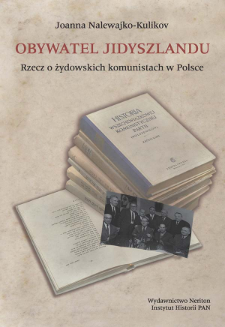
Title: Obywatel Jidyszlandu : rzecz o żydowskich komunistach w Polsce

Subtitle:
Citizen of Yiddishland. About the Jewish communists in Poland
Contributor:
Instytut Historii Polskiej Akademii Nauk
Publisher:
Wydawnictwo Neriton ; Instytut Historii PAN [Polskiej Akademii Nauk]
Place of publishing:
Description:
Bibliogr. s. 309-335. Indeks ; 348, [2] s., [16] s. tabl. : il. ; 24 cm ; Streszcz ang.
Abstract:
A saying that is often quoted in Poland in relation to Jewish communists or communists of Jewish origin goes that “a Jewish communist is not Jewish anymore”. This is true concerning those Jews who considered themselves Polish communists and who worked mostly in a non-Jewish environment. However, some Jews who joined the communist party in the interwar period never denied their Jewishness. On the contrary, they lived and worked on the so-called “Jewish street”. They were not a large group, but their influence on the Polish Jewish community was inversely proportional to their number. A good example of such a Jewish communist is a Yiddish writer and activist David Sfard. Born at the beginning of the 20th century in a rabbi’s family in Volhynia (then in the Russian Empire), he received at first a traditional religious education, but after World War I he entered a secular Polish-Jewish gymnasium in Lutsk. The Polish-Soviet war of 1920 was his first meeting with the communist ideology brought to Volhynia by the Red Army. Later he studied philosophy in Warsaw and eventually received his PhD in philosophy from the university in Nancy, France. Having returned to Warsaw, he joined in 1933 the illegal Communist Party of Poland and became active in Yiddish literary circles, including the literary journal “Literarishe Tribune” (1932–1933), the crypto-communist daily “Fraynd” (1934–1935) and the famous Association of Jewish Writers and Journalists at Tlomatske 13. In 1939, at the outbreak of World War II, he escaped to the Soviet-occupied Białystok where again he worked in the Yiddish newspaper “Bialistoker Shtern”. After the Nazis attacked the USSR in 1941, he was evacuated with other Jewish writers to Alma-Ata (Kazakhstan). When he got to Moscow in 1944, he co-founded the Organizing Committee of Polish Jews at the Polish Patriots’ Union (ZPP), an organization that kept in close touch with the Jewish Anti-Fascist Committee. As its vice-chairman and later chairman, he coordinated the repatriation of Polish Jews to Poland and came back himself in 1946, finally settling down in Warsaw. The first-hand experience of the Soviet reality did not put off neither him, nor his fellows from the Jewish faction of the Polish Workers’ Party (PPR). On the contrary, they believed that it would allow them to build the right form of communism in liberated Poland. Their political vision of a particular Polish way to communism was labeled as nusekh Poyln, or “the Polish variant”, and its key element was Yiddish culture. [...] While David Sfard is the main hero of this book, much emphasis has also been given to his Jewish communist fellows, such as David Rikhter, Shimen Zachariasz, Hersh Smolar, Bernard Mark and Binem Heller. The whole community of Jewish communists was shown against the background of history of Jews in Eastern Europe. This book is a panorama of an individual Jewish fate in the 20 th century, a fate that became symbolic for a whole generation – the last citizens of Yiddishland.
Detailed Resource Type:
Format:
Resource Identifier:
oai:rcin.org.pl:64196 ; 978-83-7543-064-6
Source:
IH PAN, sygn. II.12264 ; IH PAN, sygn. II.12263 Podr. ; click here to follow the link
Language:
Language of abstract:
Rights:
Licencja Creative Commons Uznanie autorstwa-Bez utworów zależnych 4.0
Terms of use:
Zasób chroniony prawem autorskim. [CC BY-ND 4.0 Międzynarodowe] Korzystanie dozwolone zgodnie z licencją Creative Commons Uznanie autorstwa-Bez utworów zależnych 4.0, której pełne postanowienia dostępne są pod adresem: ; -
Digitizing institution:
Instytut Historii Polskiej Akademii Nauk
Original in:
Biblioteka Instytutu Historii PAN
Access:
Object collections:
- Digital Repository of Scientific Institutes > Partners' collections > Institute of History PAS > Books
- Digital Repository of Scientific Institutes > Partners' collections > Institute of History PAS > Institute Publications
- Digital Repository of Scientific Institutes > Partners' collections > Institute of History PAS > Institute Publications > Books
- Digital Repository of Scientific Institutes > Literature > Books/Chapters
Last modified:
Sep 12, 2025
In our library since:
Jan 26, 2018
Number of object content downloads / hits:
9942
All available object's versions:
https://rcin.org.pl/publication/83656
Show description in RDF format:
Show description in RDFa format:
Show description in OAI-PMH format:
| Edition name | Date |
|---|---|
| Nalewajko-Kulikov, Joanna (1976- ), Obywatel Jidyszlandu : rzecz o żydowskich komunistach w Polsce | Sep 12, 2025 |
Objects Similar
Wierzbicki, Marek (1964– )
Piotrowski, Jacek (1967– )
Szaynok, Bożena (1965– )
Tokarska-Bakir, Joanna
Krzyżanowski, Łukasz Zaremba, Marcin (1966– )
Rykała, Andrzej Wosiak, Anna
Ádám, István Pál
Forecki, Piotr (1978– )