- O repozytorium
- Kolekcje
- Indeksy
- Historia przeglądania
-
Repozytoria RCIN
-
 INSTYTUT ARCHEOLOGII I ETNOLOGII POLSKIEJ AKADEMII NAUK
-
 INSTYTUT BADAŃ LITERACKICH POLSKIEJ AKADEMII NAUK
-
 INSTYTUT BADAWCZY LEŚNICTWA
-
 INSTYTUT BIOLOGII DOŚWIADCZALNEJ IM. MARCELEGO NENCKIEGO POLSKIEJ AKADEMII NAUK
-
 INSTYTUT BIOLOGII SSAKÓW POLSKIEJ AKADEMII NAUK
-
 INSTYTUT CHEMII FIZYCZNEJ PAN
-
 INSTYTUT CHEMII ORGANICZNEJ PAN
-
 INSTYTUT FILOZOFII I SOCJOLOGII PAN
-
 INSTYTUT GEOGRAFII I PRZESTRZENNEGO ZAGOSPODAROWANIA PAN
-
 INSTYTUT HISTORII im. TADEUSZA MANTEUFFLA POLSKIEJ AKADEMII NAUK
-
 INSTYTUT JĘZYKA POLSKIEGO POLSKIEJ AKADEMII NAUK
-
 INSTYTUT MATEMATYCZNY PAN
-
 INSTYTUT MEDYCYNY DOŚWIADCZALNEJ I KLINICZNEJ IM.MIROSŁAWA MOSSAKOWSKIEGO POLSKIEJ AKADEMII NAUK
-
 INSTYTUT PODSTAWOWYCH PROBLEMÓW TECHNIKI PAN
-
 INSTYTUT SLAWISTYKI PAN
-
 SIEĆ BADAWCZA ŁUKASIEWICZ - INSTYTUT TECHNOLOGII MATERIAŁÓW ELEKTRONICZNYCH
-
 MUZEUM I INSTYTUT ZOOLOGII POLSKIEJ AKADEMII NAUK
-
 INSTYTUT BADAŃ SYSTEMOWYCH PAN
-
 INSTYTUT BOTANIKI IM. WŁADYSŁAWA SZAFERA POLSKIEJ AKADEMII NAUK
-
- Wyszukaj w całym Repozytorium
- Piśmiennictwo i mapy
- Archeologia
- Baza Młynów
- Nauki przyrodnicze
Wyszukiwanie zaawansowane
Wyszukiwanie zaawansowane
Wyszukiwanie zaawansowane
Wyszukiwanie zaawansowane
Wyszukiwanie zaawansowane

Obiekt
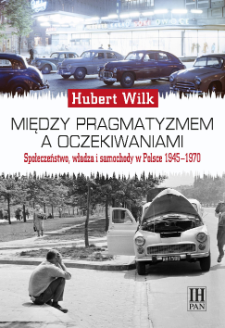
Tytuł: Między pragmatyzmem a oczekiwaniami : społeczeństwo, władza i samochody w Polsce 1945-1970

Inny tytuł:
Between pragmatism and expectations : society, state power, and carsi n Poland 1945–1970
Wydawca:
Miejsce wydania:
Opis:
Wydanie 1. ; Bibliography (pages 376-385). Index ; 395 pages : illustrations ; 24 cm ; Summary in English.
Abstrakt:
The purpose of the book is an analysis of the state policy towards individual motorisation and its social reception. On the basis of various source materials the author reconstructs the motorisation reality in the period between 1945 and 1970. In the first years after the war, several central institutions were established that were to set the development directions of motorization, but no one fulfilled their task. Initially, there were plans for individual motorization, but finally both in the three-year and six-year plans it was the collective transport that was backed up, and most important were lorries and tractors. The only passenger car that was to be manufactured in a newly built Passenger Automobile Factory (Fabryka Samochodów Osobowych – FSO) at Żerań was the FSO Warszawa, constructed under the Soviet Pobeda license provided free of charge. The most important task in the first post-war years was the reconstruction of vehicle fleet. Initially, the basic source of vehicles were UNRRA relief supplies, cars brought to Poland as the purchase of surplus army vehicles, and a small amount of imported new cars. As a result, there were in Poland in the latter half of the 1940s several dozens of various makes and brands of cars in various technical conditions. It was extremely difficult to provide necessary back-up service. Legal regulations divided the vehicle fleet into standard makes which from that time on were to have an access to spare parts and servicing, and non-standard makes that were deprived of that assistance. Private car users faced many problems with the access to cars, petrol, but also with the freedom of movement. And it was not until the Polish October of 1956 that a change occurred, when the new political authorities began to look more favourably at the development of individual motorization. New hopes for the change in policy for passenger cars were brought about by the new cars of Polish construction: FSO Syrena and MR Mikrus – the vehicles reflecting motorization trends of Western Europe. Also at the highest levels of state authority there were some ideas to base the motorization development on a Western-European license and on the production of compact cars. Finally, however, in 1965 a contract with Italian company “Fiat” was signed and the Passenger Automobile Factory FSO began the production of the Fiat 125 – a middle capacity engine car, destined for export – thus wrecking the hopes of Poles for the better access to an inexpensive and compact car that would contribute to the motorization of the Polish people. Both new Polish cars, and imported ones were sold for cash and under retail instalment contracts by the state enterprise Motozbyt to those people who were able to provide evidence that they needed their own car for professional purposes. At the same time high prices of new cars, equal to several dozens of average monthly wages, made the hopes of the majority of Poles of their own “four wheels” disappear. It was much more easy to buy a second-hand car. Other important possibilities to purchase a car were offered by private advertisements and car auctions organised from the mid-sixties, together with a quarterly lottery held by the bank that offered to people with a special account the opportunity to participate in a drawing for a new car once every three months. Despite this narrow range of possibilities to purchase a car, the number of vehicles in private hands was growing at high pace during the analysed period. It was still much less, however, than in other socialist countries, not to mention West European countries. The growing number of cars on the road in Poland was accompanied by a very slow improvement of the automotive infrastructure. The growing number of cars on the Polish roads brought about a growing number of road accidents – Poland was at the forefront of disgraceful statistics on road traffic deaths, often caused by drivers under the influence of alcohol.
Szczegółowy typ zasobu:
Identyfikator zasobu:
oai:rcin.org.pl:238961 ; 978-83-65880-07-9
Źródło:
IH PAN, call no. II.14247 ; IH PAN, call no. II.14246 Podr. ; kliknij tutaj, żeby przejść
Język:
Język streszczenia:
Prawa:
Creative Commons Attribution BY-ND 4.0 license
Zasady wykorzystania:
Copyright-protected material. [CC BY-ND 4.0] May be used within the scope specified in Creative Commons Attribution BY-ND 4.0 license, full text available at: ; -
Digitalizacja:
Institute of History of the Polish Academy of Sciences
Lokalizacja oryginału:
Library of the Institute of History PAS
Dostęp:
Kolekcje, do których przypisany jest obiekt:
- Repozytorium Cyfrowe Instytutów Naukowych > Kolekcje Partnerów > Instytut Historii PAN
- Repozytorium Cyfrowe Instytutów Naukowych > Kolekcje Partnerów > Instytut Historii PAN > Książki
- Repozytorium Cyfrowe Instytutów Naukowych > Kolekcje Partnerów > Instytut Historii PAN > Wydawnictwa Instytutu
- Repozytorium Cyfrowe Instytutów Naukowych > Kolekcje Partnerów > Instytut Historii PAN > Wydawnictwa Instytutu > Książki
- Repozytorium Cyfrowe Instytutów Naukowych > Piśmiennictwo
- Repozytorium Cyfrowe Instytutów Naukowych > Piśmiennictwo > Książki/Rozdziały
Data ostatniej modyfikacji:
17 wrz 2025
Data dodania obiektu:
1 lip 2023
Liczba pobrań / odtworzeń:
936
Wszystkie dostępne wersje tego obiektu:
https://rcin.org.pl/publication/275178
Wyświetl opis w formacie RDF:
Wyświetl opis w formacie RDFa:
Wyświetl opis w formacie OAI-PMH:
| Nazwa wydania | Data |
|---|---|
| Wilk, Hubert (1979– ), Między pragmatyzmem a oczekiwaniami : społeczeństwo, władza i samochody w Polsce 1945-1970 | 17 wrz 2025 |
Obiekty Podobne
„Nawet samochodów nie ma, zostały graty po Niemcach” – motoryzacyjny punkt startu – Polska 1944–1949
Wilk, Hubert (1979– )
Wilk, Hubert (1979– )
Wilk, Hubert (1979– )
Kochanowski, Jerzy (1960– )
Wilk, Hubert (1979– )
Wilk, Hubert (1979– )