- About project
- Collections
- Indexes
- Recently viewed
-
RCIN Repositories
-
 INSTYTUT ARCHEOLOGII I ETNOLOGII POLSKIEJ AKADEMII NAUK
-
 INSTYTUT BADAŃ LITERACKICH POLSKIEJ AKADEMII NAUK
-
 INSTYTUT BADAWCZY LEŚNICTWA
-
 INSTYTUT BIOLOGII DOŚWIADCZALNEJ IM. MARCELEGO NENCKIEGO POLSKIEJ AKADEMII NAUK
-
 INSTYTUT BIOLOGII SSAKÓW POLSKIEJ AKADEMII NAUK
-
 INSTYTUT CHEMII FIZYCZNEJ PAN
-
 INSTYTUT CHEMII ORGANICZNEJ PAN
-
 INSTYTUT FILOZOFII I SOCJOLOGII PAN
-
 INSTYTUT GEOGRAFII I PRZESTRZENNEGO ZAGOSPODAROWANIA PAN
-
 INSTYTUT HISTORII im. TADEUSZA MANTEUFFLA POLSKIEJ AKADEMII NAUK
-
 INSTYTUT JĘZYKA POLSKIEGO POLSKIEJ AKADEMII NAUK
-
 INSTYTUT MATEMATYCZNY PAN
-
 INSTYTUT MEDYCYNY DOŚWIADCZALNEJ I KLINICZNEJ IM.MIROSŁAWA MOSSAKOWSKIEGO POLSKIEJ AKADEMII NAUK
-
 INSTYTUT PODSTAWOWYCH PROBLEMÓW TECHNIKI PAN
-
 INSTYTUT SLAWISTYKI PAN
-
 SIEĆ BADAWCZA ŁUKASIEWICZ - INSTYTUT TECHNOLOGII MATERIAŁÓW ELEKTRONICZNYCH
-
 MUZEUM I INSTYTUT ZOOLOGII POLSKIEJ AKADEMII NAUK
-
 INSTYTUT BADAŃ SYSTEMOWYCH PAN
-
 INSTYTUT BOTANIKI IM. WŁADYSŁAWA SZAFERA POLSKIEJ AKADEMII NAUK
-
- Search in all Repository
- Literature and maps
- Archeology
- Mills database
- Natural sciences
Advanced search
Advanced search
Advanced search
Advanced search
Advanced search

Object
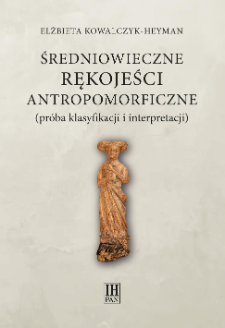
Title: Średniowieczne rękojeści antropomorficzne : (próba klasyfikacji i interpretacji)

Subtitle:
Mediaeval anthropomorphic handles (an attempt at their classification and interpretation)
Institutional creator:
Polska Akademia Nauk, Instytut Historii im. Tadeusza Manteuffla
 ;
Uniwersytet Warszawski. Wydział Archeologii
;
Uniwersytet Warszawski. Wydział Archeologii
Publisher:
Place of publishing:
Description:
Wydanie I. ; 229 pages, 1 page unnumbered, [12] leaves of plates folded : illustrations ; 24 cm ; Bibliography (pages 214-224). Index ; Publication supported by University of Warsaw ; Summary in English
Abstract:
The subject of the research is a group of mediaeval, anthropomorphic handles of small tools – knives, pins used for styling hair, and ear scoops (spatulas) – with single and double representations of complete standing human figures. In terms of the subject matter and presented symbols, places of production, the material used, the artistic level and technique of craft and their intended use, they do not constitute a uniform group. The decoration of knife handles with human figures, known in the Roman era, revived in the Middle Ages in Western Europe. The current state of research makes it possible to observe that instruments with such handles were widespread throughout Central and Western Europe, including northern Italy, the British Isles, Scandinavia, and the south-eastern Baltic zone. However only knives were so widely spread. After excluding artefacts of unknown provenance, it can be said that other tools with such handles have been found so far only in the territory of France, Belgium and the British Isles. The collected and analysed group includes 160 items. One of the research aims was to determine the artefacts’ features that would allow systematising, and thus creating a system of classification of the handles. It was possible to distinguish six types of the analysed artefacts. They are based on the types of props accompanying the images of single figures or their absence and representations of the two figures. Within these types, the subtypes, varieties and variants have been distinguished
Detailed Resource Type:
Resource Identifier:
oai:rcin.org.pl:239806 ; 978-83-65880-96-3
Source:
IH PAN, call no. II.15220 ; IH PAN, call no. II.15219 Podr. ; click here to follow the link
Language:
Language of abstract:
Rights:
Creative Commons Attribution BY-NC-ND 4.0 license
Terms of use:
Copyright-protected material. [CC BY-NC-ND 4.0] May be used within the scope specified in Creative Commons Attribution BY-NC-ND 4.0 license, full text available at: ; -
Digitizing institution:
Institute of History of the Polish Academy of Sciences
Original in:
Library of the Institute of History PAS
Access:
Object collections:
- Digital Repository of Scientific Institutes > Partners' collections > Institute of History PAS
- Digital Repository of Scientific Institutes > Partners' collections > Institute of History PAS > Books
- Digital Repository of Scientific Institutes > Partners' collections > Institute of History PAS > Institute Publications
- Digital Repository of Scientific Institutes > Partners' collections > Institute of History PAS > Institute Publications > Books
- Digital Repository of Scientific Institutes > Literature
- Digital Repository of Scientific Institutes > Literature > Books/Chapters
Last modified:
Sep 12, 2025
In our library since:
Nov 13, 2023
Number of object content downloads / hits:
1 179
All available object's versions:
https://rcin.org.pl/publication/276170
Show description in RDF format:
Show description in RDFa format:
Show description in OAI-PMH format:
| Edition name | Date |
|---|---|
| Kowalczyk, Elżbieta (1945– ), Średniowieczne rękojeści antropomorficzne : (próba klasyfikacji i interpretacji) | Sep 12, 2025 |
Objects Similar
Kowalczyk, Elżbieta (1945– )
Kowalczyk, Elżbieta (1945– )
Kowalczyk, Elżbieta (1945– )
Kowalczyk, Elżbieta (1945– )
Kowalczyk, Elżbieta (1945– )
Kowalczyk, Elżbieta (1945– )
Kowalczyk, Elżbieta (1945– )
Długokęcki, Wiesław (1957– ) Kowalczyk, Elżbieta (1945– )