- O repozytorium
- Kolekcje
- Indeksy
- Historia przeglądania
-
Repozytoria RCIN
-
 INSTYTUT ARCHEOLOGII I ETNOLOGII POLSKIEJ AKADEMII NAUK
-
 INSTYTUT BADAŃ LITERACKICH POLSKIEJ AKADEMII NAUK
-
 INSTYTUT BADAWCZY LEŚNICTWA
-
 INSTYTUT BIOLOGII DOŚWIADCZALNEJ IM. MARCELEGO NENCKIEGO POLSKIEJ AKADEMII NAUK
-
 INSTYTUT BIOLOGII SSAKÓW POLSKIEJ AKADEMII NAUK
-
 INSTYTUT CHEMII FIZYCZNEJ PAN
-
 INSTYTUT CHEMII ORGANICZNEJ PAN
-
 INSTYTUT FILOZOFII I SOCJOLOGII PAN
-
 INSTYTUT GEOGRAFII I PRZESTRZENNEGO ZAGOSPODAROWANIA PAN
-
 INSTYTUT HISTORII im. TADEUSZA MANTEUFFLA POLSKIEJ AKADEMII NAUK
-
 INSTYTUT JĘZYKA POLSKIEGO POLSKIEJ AKADEMII NAUK
-
 INSTYTUT MATEMATYCZNY PAN
-
 INSTYTUT MEDYCYNY DOŚWIADCZALNEJ I KLINICZNEJ IM.MIROSŁAWA MOSSAKOWSKIEGO POLSKIEJ AKADEMII NAUK
-
 INSTYTUT PODSTAWOWYCH PROBLEMÓW TECHNIKI PAN
-
 INSTYTUT SLAWISTYKI PAN
-
 SIEĆ BADAWCZA ŁUKASIEWICZ - INSTYTUT TECHNOLOGII MATERIAŁÓW ELEKTRONICZNYCH
-
 MUZEUM I INSTYTUT ZOOLOGII POLSKIEJ AKADEMII NAUK
-
 INSTYTUT BADAŃ SYSTEMOWYCH PAN
-
 INSTYTUT BOTANIKI IM. WŁADYSŁAWA SZAFERA POLSKIEJ AKADEMII NAUK
-
- Wyszukaj w całym Repozytorium
- Piśmiennictwo i mapy
- Archeologia
- Baza Młynów
- Nauki przyrodnicze
Wyszukiwanie zaawansowane
Wyszukiwanie zaawansowane
Wyszukiwanie zaawansowane
Wyszukiwanie zaawansowane
Wyszukiwanie zaawansowane

Obiekt
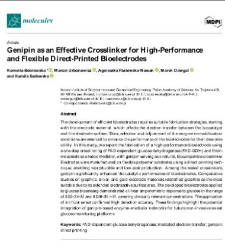
Tytuł: Genipin as an Effective Crosslinker for High-Performance and Flexible Direct-Printed Bioelectrodes
Twórca:
Bobrowska, Kornelia
;
Urbanowicz, Marcin
;
Paziewska-Nowak, Agnieszka
;
Dawgul, Marek
;
Sadowska, Kamila
:
kierownik projektu

Data wydania/powstania:
Typ zasobu:
Wydawca:
Data publ. on-line:
Opis:
Dyscyplina :
Abstrakt:
The development of efficient bioelectrodes requires suitable fabrication strategies, starting with the electrode material, which affects the electron transfer between the biocatalyst and the electrode surface. Then, selection and adjustment of the enzyme immobilization conditions are essential to enhance the performance of the bioelectrodes for their desirable utility. In this study, we report the fabrication of a high-performance bioelectrode using a one-step crosslinking of FAD-dependent glucose dehydrogenase (FAD-GDH) and thionine acetate as a redox mediator, with genipin serving as a natural, biocompatible crosslinker. Electrodes were manufactured on flexible polyester substrates using a direct printing technique, enabling reproducible and low-cost production. Among the tested crosslinkers, genipin significantly enhanced the catalytic performance of bioelectrodes. Comparative studies on graphite, silver, and gold electrode materials identified graphite as the most suitable due to its extended electroactive surface area. The developed bioelectrodes applied to glucose biosensing demonstrated a linear amperometric response to glucose in the range of 0.02–2 mM and 0.048–30 mM, covering clinically relevant concentrations. The application of artificial sweat confirmed high detection accuracy. These findings highlight the potential integration of genipin-based enzyme–mediator networks for future non-invasive sweat glucose monitoring platforms.
Czasopismo/Seria/cykl:
Szczegółowy typ zasobu:
Article : original article ; Artykuł
Format:
Identyfikator zasobu:
Źródło:
Język:
Prawa:
Zasady wykorzystania:
Właściciel praw autorskich:
Instytut Biocybernetyki i Inżynierii Biomedycznej im. M.Nałęcza PAN
Dofinansowane ze środków:
Tagi:
Dostęp:
Kolekcje, do których przypisany jest obiekt:
- Repozytorium Cyfrowe Instytutów Naukowych > Kolekcje Partnerów > Instytut Biocybernetyki i Inżynierii Biomedycznej im. Macieja Nałęcza PAN > Dane naukowe
Data ostatniej modyfikacji:
26 mar 2026
Data dodania obiektu:
24 mar 2026
Liczba pobrań / odtworzeń:
55
Wszystkie dostępne wersje tego obiektu:
https://rcin.org.pl/publication/290352
Wyświetl opis w formacie RDF:
Wyświetl opis w formacie RDFa:
Wyświetl opis w formacie OAI-PMH:
| Nazwa wydania | Data |
|---|---|
| K.Bobrowska; Molecules 2026 | 26 mar 2026 |
Obiekty Podobne
Bobrowska, Kornelia
Luhar, Sunil Sadowska, Kamila