- About project
- Collections
- Indexes
- Recently viewed
-
RCIN Repositories
-
 INSTYTUT ARCHEOLOGII I ETNOLOGII POLSKIEJ AKADEMII NAUK
-
 INSTYTUT BADAŃ LITERACKICH POLSKIEJ AKADEMII NAUK
-
 INSTYTUT BADAWCZY LEŚNICTWA
-
 INSTYTUT BIOLOGII DOŚWIADCZALNEJ IM. MARCELEGO NENCKIEGO POLSKIEJ AKADEMII NAUK
-
 INSTYTUT BIOLOGII SSAKÓW POLSKIEJ AKADEMII NAUK
-
 INSTYTUT CHEMII FIZYCZNEJ PAN
-
 INSTYTUT CHEMII ORGANICZNEJ PAN
-
 INSTYTUT FILOZOFII I SOCJOLOGII PAN
-
 INSTYTUT GEOGRAFII I PRZESTRZENNEGO ZAGOSPODAROWANIA PAN
-
 INSTYTUT HISTORII im. TADEUSZA MANTEUFFLA POLSKIEJ AKADEMII NAUK
-
 INSTYTUT JĘZYKA POLSKIEGO POLSKIEJ AKADEMII NAUK
-
 INSTYTUT MATEMATYCZNY PAN
-
 INSTYTUT MEDYCYNY DOŚWIADCZALNEJ I KLINICZNEJ IM.MIROSŁAWA MOSSAKOWSKIEGO POLSKIEJ AKADEMII NAUK
-
 INSTYTUT PODSTAWOWYCH PROBLEMÓW TECHNIKI PAN
-
 INSTYTUT SLAWISTYKI PAN
-
 SIEĆ BADAWCZA ŁUKASIEWICZ - INSTYTUT TECHNOLOGII MATERIAŁÓW ELEKTRONICZNYCH
-
 MUZEUM I INSTYTUT ZOOLOGII POLSKIEJ AKADEMII NAUK
-
 INSTYTUT BADAŃ SYSTEMOWYCH PAN
-
 INSTYTUT BOTANIKI IM. WŁADYSŁAWA SZAFERA POLSKIEJ AKADEMII NAUK
-
- Search in all Repository
- Literature and maps
- Archeology
- Mills database
- Natural sciences
Advanced search
Advanced search
Advanced search
Advanced search
Advanced search

Object
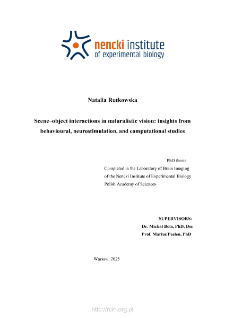
Title: Scene-object interactions in naturalistic vision: insights from behavioural, neurostimulation and computational studies : PhD thesis
Contributor:
Bola, Michał (1986– ) : Supervisor ; Peelen, Marius : Supervisor
Publisher:
Nencki Institute of Experimental Biology PAS
Place of publishing:
Description:
[1], 141 pages : illustrations ; 30 cm ; Bibliography ; Summary in Polish
Degree name:
Degree discipline :
Degree grantor:
Nencki Institute of Experimental Biology PAS ; degree obtained: 2026
Type of object:
Abstract:
Perception of the visual world is strikingly fast and seemingly effortless. How such efficiency is neurally and computationally implemented remains a long-standing question. Neuroscientific research has identified partially segregated scene- and object-selective pathways in the human visual system, yet it is still unclear how and when these pathways interact. This thesis investigated their interaction in human vision, drawing on existing theoretical accounts. As a complementary benchmark, a computer model of human vision was evaluated to assess the extent to which the observed effects can be reproduced in a feedforward artificial architecture. In all studies, naturalistic photographs served as proxies for real-world input. Study 1 tested whether one of the representations – scene context or objects – exhibits a temporal processing advantage and in what sequence these elements influence one another. Participants classified scenes and objects in two tasks: a go/no-go task and a two-alternative forced-choice (2AFC) task. Reaction times were analysed alongside the integrated speed – accuracy measure (Balanced Integration Score) to control for speed–accuracy trade-offs. After controlling for these trade-offs, no reliable temporal advantage was observed for either representation. The influences were mutual, with incongruent objects slowing scene context recognition and incongruent context slowing object recognition. Study 2 examined whether object representations play a causal role in disambiguating scenes. Using chronometric TMS, the study assessed whether the object-selective lateral occipital complex (LOC) makes a causal, time-specific contribution to the categorization of ambiguous scenes, in parallel to the established role of the scene-selective occipital place area (OPA) in the classification of ambiguous objects. It was further assessed whether the effective temporal window of the LOC coincides with the one previously reported for the OPA. Accuracy, reaction times, and integrated speed–accuracy measure (LISAS) were compared across three stimulation windows. Results support a causal contribution of the LOC to the disambiguation of scenes, although its precise timing could not be conclusively established. Study 3 investigated whether object-facilitated scene recognition requires a coherent scene layout or can still occur when only low-level scene statistics are preserved. It further examined whether this dependency is uniquely human or can also be instantiated within a feedforward artificial architecture. Human participants classified scenes with objects placed on ambiguous scenes, phase-scrambled scenes, and neutral backgrounds. Performance showed that a coherent layout is critical for object-based facilitation. The same images were classified by Places365-GoogLeNet, and model performance was not significantly different from human behaviour under these manipulations. Taken together, the results provide little support for strictly hierarchical (“object-first” or “scene-first”) accounts of real-world scene perception – there is no temporal processing advantage for either scene or object representation, and their influences are mutual. Critically, it is shown for the first time that object representations in the LOC make a causal contribution to the recognition of ambiguous scenes. Pinpointing the precise temporal window of this contribution will be essential for evaluating whether scene–object interactions are implemented via a shared bidirectional predictive processing mechanism. It is further demon strated that object-based facilitation of scene recognition depends on a coherent scene layout, and that classification accuracy across conditions does not differ significantly between human observers and the artificial neural network. An important task for future work will therefore be to specify the conditions under which human and model processing diverge (...)
Detailed Resource Type:
Resource Identifier:
Source:
Language:
Language of abstract:
Rights:
Terms of use:
Copyright-protected material. May be used within the limits of statutory user freedoms
Copyright holder:
Publication made available with the written permission of the author
Digitizing institution:
Nencki Institute of Experimental Biology of the Polish Academy of Sciences
Original in:
Library of the Nencki Institute of Experimental Biology PAS
Access:
Object collections:
- Digital Repository of Scientific Institutes > Partners' collections > Nencki Institute of Experimental Biology PAS
- Digital Repository of Scientific Institutes > Partners' collections > Nencki Institute of Experimental Biology PAS > Dissertations
- Digital Repository of Scientific Institutes > Partners' collections > Nencki Institute of Experimental Biology PAS > Dissertations > PhD Thesis
- Digital Repository of Scientific Institutes > Literature > Thesis
Last modified:
Oct 5, 2026
In our library since:
Oct 5, 2026
Number of object content downloads / hits:
5
All available object's versions:
https://rcin.org.pl/publication/300465
Show description in RDF format:
Show description in RDFa format:
Show description in OAI-PMH format:
Objects Similar
Bednarek, Dorota
Dzwiniel, Piotr
Nováková, Gabriela Šebo, Dušan
Mazurowski, Ryszard F.
Bálek, Miroslav Hašek, Vladimir Ondruš, Vladimir Segeth, Karel
Kartanas, Edmund Lipiński, Eryk J.