- O repozytorium
- Kolekcje
- Indeksy
- Historia przeglądania
-
Repozytoria RCIN
-
 INSTYTUT ARCHEOLOGII I ETNOLOGII POLSKIEJ AKADEMII NAUK
-
 INSTYTUT BADAŃ LITERACKICH POLSKIEJ AKADEMII NAUK
-
 INSTYTUT BADAWCZY LEŚNICTWA
-
 INSTYTUT BIOLOGII DOŚWIADCZALNEJ IM. MARCELEGO NENCKIEGO POLSKIEJ AKADEMII NAUK
-
 INSTYTUT BIOLOGII SSAKÓW POLSKIEJ AKADEMII NAUK
-
 INSTYTUT CHEMII FIZYCZNEJ PAN
-
 INSTYTUT CHEMII ORGANICZNEJ PAN
-
 INSTYTUT FILOZOFII I SOCJOLOGII PAN
-
 INSTYTUT GEOGRAFII I PRZESTRZENNEGO ZAGOSPODAROWANIA PAN
-
 INSTYTUT HISTORII im. TADEUSZA MANTEUFFLA POLSKIEJ AKADEMII NAUK
-
 INSTYTUT JĘZYKA POLSKIEGO POLSKIEJ AKADEMII NAUK
-
 INSTYTUT MATEMATYCZNY PAN
-
 INSTYTUT MEDYCYNY DOŚWIADCZALNEJ I KLINICZNEJ IM.MIROSŁAWA MOSSAKOWSKIEGO POLSKIEJ AKADEMII NAUK
-
 INSTYTUT PODSTAWOWYCH PROBLEMÓW TECHNIKI PAN
-
 INSTYTUT SLAWISTYKI PAN
-
 SIEĆ BADAWCZA ŁUKASIEWICZ - INSTYTUT TECHNOLOGII MATERIAŁÓW ELEKTRONICZNYCH
-
 MUZEUM I INSTYTUT ZOOLOGII POLSKIEJ AKADEMII NAUK
-
 INSTYTUT BADAŃ SYSTEMOWYCH PAN
-
 INSTYTUT BOTANIKI IM. WŁADYSŁAWA SZAFERA POLSKIEJ AKADEMII NAUK
-
- Wyszukaj w całym Repozytorium
- Piśmiennictwo i mapy
- Archeologia
- Baza Młynów
- Nauki przyrodnicze
Wyszukiwanie zaawansowane
Wyszukiwanie zaawansowane
Wyszukiwanie zaawansowane
Wyszukiwanie zaawansowane
Wyszukiwanie zaawansowane

Obiekt
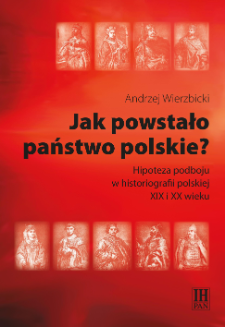
Tytuł: Jak powstało państwo polskie? : hipoteza podboju w historiografii polskiej XIX i XX wieku
Inny tytuł:
Współtwórca:
Polska Akademia Nauk. Instytut Historii im. Tadeusza Manteuffla
Wydawca:
Miejsce wydania:
Opis:
Wydanie I. ; 336 pages ; 25 cm ; Index. ; Summary in English
Abstrakt:
While a main reference point in the present book is a hypothesis of conquest, it does not mean that other “theories and hypotheses” are being omitted, including those which for a long time were regarded by numerous historians at least as the “only right ones” if not “the only scientific ones”. Thus, besides the hypotheses of conquest, conforming to an event-driven convention (a one-time act), I have also taken into account processual-evolutionary approaches, including Marxist ones, as well as “mixed” concepts – in one way or another combining these opposed approaches. All things considered, this is a book about the frequently visited but at the same time the least illuminated corner of our (Polish) past, mainly due to the scarcity of written sources and their character allowing for various discrepant interpretations. My presentation of concepts of the birth of the Polish state resulting from one or many conquests of intra- or extra-ethnic character occurring in the Polish historical thought I begin with the emergence of the so-called critical historiography, i.e. the second half of the eighteenth century, and finish with the “official” historiography of the Polish People’s Republic. What has happened since that time cannot be regarded as a “closed” period making it possible, broadly speaking, to unemotionally grasp new trends or to present them in a way that would eliminate the subjectivity of the authors. It does not mean, however, that I have totally ignored “our times”. In the closing part of the book I venture to present certain preliminary remarks on historiographical tendencies from the most recent past. The hypothesis of conquest that led to the formation of the Polish state made and still makes a peculiar phantom of our historiography. It was emerging and establishing in the ideology and political thought of the Enlightenment period, and then occurred in various forms in the historiography of the 19th century, but also disappeared almost completely, like during the closing decades of that century, in the interwar period, and in People’s Poland. Neither has it been especially evident in the post-socialist phase, but it seems to be re-emerging from the dark shadows, mainly in the form of internal conquest (revolution, breakthrough), regarded usually as one of the elements of the state-building process.
Szczegółowy typ zasobu:
Identyfikator zasobu:
oai:rcin.org.pl:140138 ; 978-83-65880-55-0
Źródło:
IH PAN, call no. II.14725 ; IH PAN, call no. II.14724 Podr. ; kliknij tutaj, żeby przejść
Język:
Język streszczenia:
Prawa:
Creative Commons Attribution BY-ND 4.0 license
Zasady wykorzystania:
Copyright-protected material. [CC BY-ND 4.0] May be used within the scope specified in Creative Commons Attribution BY-ND 4.0 license, full text available at: ; -
Digitalizacja:
Institute of History of the Polish Academy of Sciences
Lokalizacja oryginału:
Library of the Institute of History PAS
Dostęp:
Kolekcje, do których przypisany jest obiekt:
- Repozytorium Cyfrowe Instytutów Naukowych > Kolekcje Partnerów > Instytut Historii PAN > Książki
- Repozytorium Cyfrowe Instytutów Naukowych > Kolekcje Partnerów > Instytut Historii PAN > Wydawnictwa Instytutu
- Repozytorium Cyfrowe Instytutów Naukowych > Kolekcje Partnerów > Instytut Historii PAN > Wydawnictwa Instytutu > Książki
- Repozytorium Cyfrowe Instytutów Naukowych > Piśmiennictwo > Książki/Rozdziały
Data ostatniej modyfikacji:
17 wrz 2025
Data dodania obiektu:
21 wrz 2020
Liczba pobrań / odtworzeń:
1553
Wszystkie dostępne wersje tego obiektu:
https://rcin.org.pl/publication/174023
Wyświetl opis w formacie RDF:
Wyświetl opis w formacie RDFa:
Wyświetl opis w formacie OAI-PMH:
| Nazwa wydania | Data |
|---|---|
| Wierzbicki, Andrzej (1942- ), Jak powstało państwo polskie? : hipoteza podboju w historiografii polskiej XIX i XX wieku | 17 wrz 2025 |
Obiekty Podobne
Wierzbicki, Andrzej (1942–2022)
Wierzbicki, Andrzej (1942–2022)
Wierzbicki, Andrzej (1942–2022)
Wierzbicki, Andrzej (1942–2022)
Wisner, Henryk (1936–2025) Czapliński, Władysław (1905–1981) Żurawicka, Janina ( –2006) Czepulis-Rastenis, Ryszarda (1928–1994) Goldberg, Jakub (1924–2011) Bitner, Wacław (1893–1981)
Domańska, Ewa Górny, Maciej (1976– ) Kornat, Marek (1971– ) Kosiński, Krzysztof (1974– ) Piasek, Wojciech Pleskot, Patryk (1980– ) Romek, Zbigniew Rutkowski, Tadeusz Paweł (1965– ) Wierzbicki, Andrzej (1942–2022) Wróbel, Piotr (1952– )
Wierzbicki, Andrzej (1942–2022)
Paskudzki, Jarosław Wierzbicki, Andrzej (1942–2022) Winnicki, Zdzisław Julian (1949– ) Eisler, Jerzy (1952– )