- About project
- Collections
- Indexes
- Recently viewed
-
RCIN Repositories
-
 INSTYTUT ARCHEOLOGII I ETNOLOGII POLSKIEJ AKADEMII NAUK
-
 INSTYTUT BADAŃ LITERACKICH POLSKIEJ AKADEMII NAUK
-
 INSTYTUT BADAWCZY LEŚNICTWA
-
 INSTYTUT BIOLOGII DOŚWIADCZALNEJ IM. MARCELEGO NENCKIEGO POLSKIEJ AKADEMII NAUK
-
 INSTYTUT BIOLOGII SSAKÓW POLSKIEJ AKADEMII NAUK
-
 INSTYTUT CHEMII FIZYCZNEJ PAN
-
 INSTYTUT CHEMII ORGANICZNEJ PAN
-
 INSTYTUT FILOZOFII I SOCJOLOGII PAN
-
 INSTYTUT GEOGRAFII I PRZESTRZENNEGO ZAGOSPODAROWANIA PAN
-
 INSTYTUT HISTORII im. TADEUSZA MANTEUFFLA POLSKIEJ AKADEMII NAUK
-
 INSTYTUT JĘZYKA POLSKIEGO POLSKIEJ AKADEMII NAUK
-
 INSTYTUT MATEMATYCZNY PAN
-
 INSTYTUT MEDYCYNY DOŚWIADCZALNEJ I KLINICZNEJ IM.MIROSŁAWA MOSSAKOWSKIEGO POLSKIEJ AKADEMII NAUK
-
 INSTYTUT PODSTAWOWYCH PROBLEMÓW TECHNIKI PAN
-
 INSTYTUT SLAWISTYKI PAN
-
 SIEĆ BADAWCZA ŁUKASIEWICZ - INSTYTUT TECHNOLOGII MATERIAŁÓW ELEKTRONICZNYCH
-
 MUZEUM I INSTYTUT ZOOLOGII POLSKIEJ AKADEMII NAUK
-
 INSTYTUT BADAŃ SYSTEMOWYCH PAN
-
 INSTYTUT BOTANIKI IM. WŁADYSŁAWA SZAFERA POLSKIEJ AKADEMII NAUK
-
- Search in all Repository
- Literature and maps
- Archeology
- Mills database
- Natural sciences
Advanced search
Advanced search
Advanced search
Advanced search
Advanced search

Object
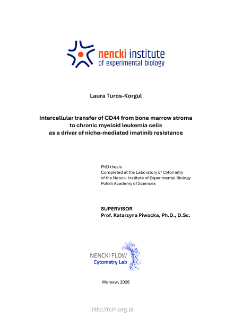
Title: Intercellular transfer of CD44 from bone marrow stroma to chronic myeloid leukemia cells as a driver of niche-mediated imatinib resistance : PhD thesis
Contributor:
Piwocka, Katarzyna (1970– ) : Supervisor
Publisher:
Nencki Institute of Experimental Biology PAS
Place of publishing:
Description:
196 pages : illustrations ; 30 cm ; Bibliography ; Summary in Polish
Degree name:
Degree discipline :
Degree grantor:
Nencki Institute of Experimental Biology PAS ; degree obtained: 2026
Type of object:
Abstract:
Intercellular communication, while essential for normal organism function, is also exploited by cancer cells to interact with both malignant and non-malignant cells, thereby promoting tumor growth and adaptation to changing environmental conditions. In myeloid leukemias, including chronic myeloid leukemia (CML), leukemic cells interact directly and indirectly with various types of cells in the bone marrow niche. This contact is essential for the immune evasion, development of resistance, and the persistence of leukemic stem cells (LSC). Among the diverse modes of cell-cell communication, tunneling nanotubes (TNTs) have emerged as a distinct, unconventional type of direct intercellular communication mechanism. TNTs enable the transfer of a wide range of cargo, including mitochondria, vesicles, or proteins, between distant cells. However, despite significant advances in research on TNTs, substantial knowledge gaps persist, limiting our full understanding of these structures, their role in cancer progression and resistance, as well as their potential clinical application. Our previous studies have shown that TNTs are exploited by bone marrow stromal cells (BMSCs) and CML cells to transfer cellular vesicles and proteins from stroma to leukemia cells. This results in the increased resistance of recipient cells to the imatinib drug. Here, we identified CD44 as one of the stromal proteins transferred to leukemia. The general aim of this work was to examine the role of the stroma-derived CD44 protein in CML recipient cells. First, the stroma-to-leukemia CD44 transfer was confirmed using confocal microscopy and flow cytometry. The results showed that the transfer strictly depends on the direct cell-cell contact between stromal and leukemia cells. Moreover, it is mediated by tunneling nanotubes formed between connected cells. The RNA-seq analysis of CML cells that received and did not receive stromal CD44 revealed that CD44 transfer is linked to increased expression of genes related to cell adhesion, extracellular matrix remodeling, and cell migration. This was accompanied by increased activity of matrix metalloproteinases and higher invasiveness of these cells. Notably, in leukemic recipient cells, the endogenous CD44 was also upregulated at both mRNA and protein levels. Stroma-driven upregulation of CD44 in CML cells was associated with the activation of the pro-survival ERK/AP-1 pathway and stroma-mediated protection from tyrosine kinase inhibitors. In vitro, pharmacological targeting of the interaction between CD44 and its main ligand, hyaluronan, disrupted stroma-driven protection and sensitized CML cells to imatinib. An additional aim of this study was to investigate the ultrastructure of TNTs, which are the primary mediators of CD44 transfer. Focused ion beam scanning electron microscopy (FIB-SEM) confirmed the presence of TNTs in the stroma-leukemia co-cultures. However, TNTs identified by confocal microscopy using the current standard criteria do not consistently meet them when examined at higher resolution, using volume electron microscopy. Therefore, it was proposed here that current approaches should be re-evaluated. Furthermore, the presented data contradicted the theory that TNTs are completely open structures, indicating the existence of a specific regulatory system controlling cargo transfer via TNTs. In summary, the studies presented in this dissertation provide new insights into stroma-driven resistance associated with horizontal CD44 protein transfer mediated by TNTs, leading to transcriptional reprogramming of leukemia acceptor cells toward a more invasive and resistant phenotype. Additionally, these findings deepen the understanding of TNTs’ ultrastructure and critically evaluate the criteria and methodologies currently employed for their identification
Detailed Resource Type:
Resource Identifier:
Source:
Language:
Language of abstract:
Rights:
Terms of use:
Copyright-protected material. May be used within the limits of statutory user freedoms
Copyright holder:
Publication made available with the written permission of the author
Digitizing institution:
Nencki Institute of Experimental Biology of the Polish Academy of Sciences
Original in:
Library of the Nencki Institute of Experimental Biology PAS
Access:
Object collections:
- Digital Repository of Scientific Institutes > Partners' collections > Nencki Institute of Experimental Biology PAS
- Digital Repository of Scientific Institutes > Partners' collections > Nencki Institute of Experimental Biology PAS > Dissertations
- Digital Repository of Scientific Institutes > Partners' collections > Nencki Institute of Experimental Biology PAS > Dissertations > PhD Thesis
- Digital Repository of Scientific Institutes > Literature > Thesis
Last modified:
Oct 7, 2026
In our library since:
Oct 7, 2026
Number of object content downloads / hits:
3
All available object's versions:
https://rcin.org.pl/publication/300462
Show description in RDF format:
Show description in RDFa format:
Show description in OAI-PMH format:
Objects Similar
Swatler, Julian
Pszczółkowska, Dominika
Pasierbińska, Maria
Dźwigońska, Monika
Segit, Paweł
Pilanc-Kudlek, Paulina